



Ever wondered how banks and customer service teams verify your identity just by hearing your voice? That’s voice biometrics at work. Think of it like a fingerprint, but for your voice.
Every person has unique vocal traits that technology can recognize and use to confirm who you are.
This security method is becoming popular because it’s fast, convenient, and hard to fake. No more remembering complicated passwords or answering endless security questions.
In this guide, you’ll learn what voice biometrics actually is, how the technology works behind the scenes, the difference between active and passive voice authentication, and why businesses trust it to keep accounts safe.
You’ll also learn about its benefits, limitations, and real-world uses across industries.
What Is Voice Biometrics?
Voice biometrics is a security technology that identifies people based on their unique voice characteristics. Just like fingerprints, no two voices are exactly alike.
The system creates a digital “voiceprint” that serves as your vocal signature for authentication.
Key Characteristics that Make Your Voice Unique:
- Vocal Tract Shape: The size and structure of your throat, mouth, and nasal passages create distinct sound patterns.
- Speech Rhythm: Your natural speaking pace, pauses between words, and overall conversational flow are uniquely yours.
- Pitch and Tone: The highness or lowness of your voice, along with its quality, helps distinguish you from others.
- Accent and Pronunciation: Regional accents and how you pronounce specific words add another layer of vocal individuality.
Here’s the important part: voice biometrics focuses on who is speaking, not what they’re saying, making it a powerful identity verification tool.
How Does Voice Biometrics Work?
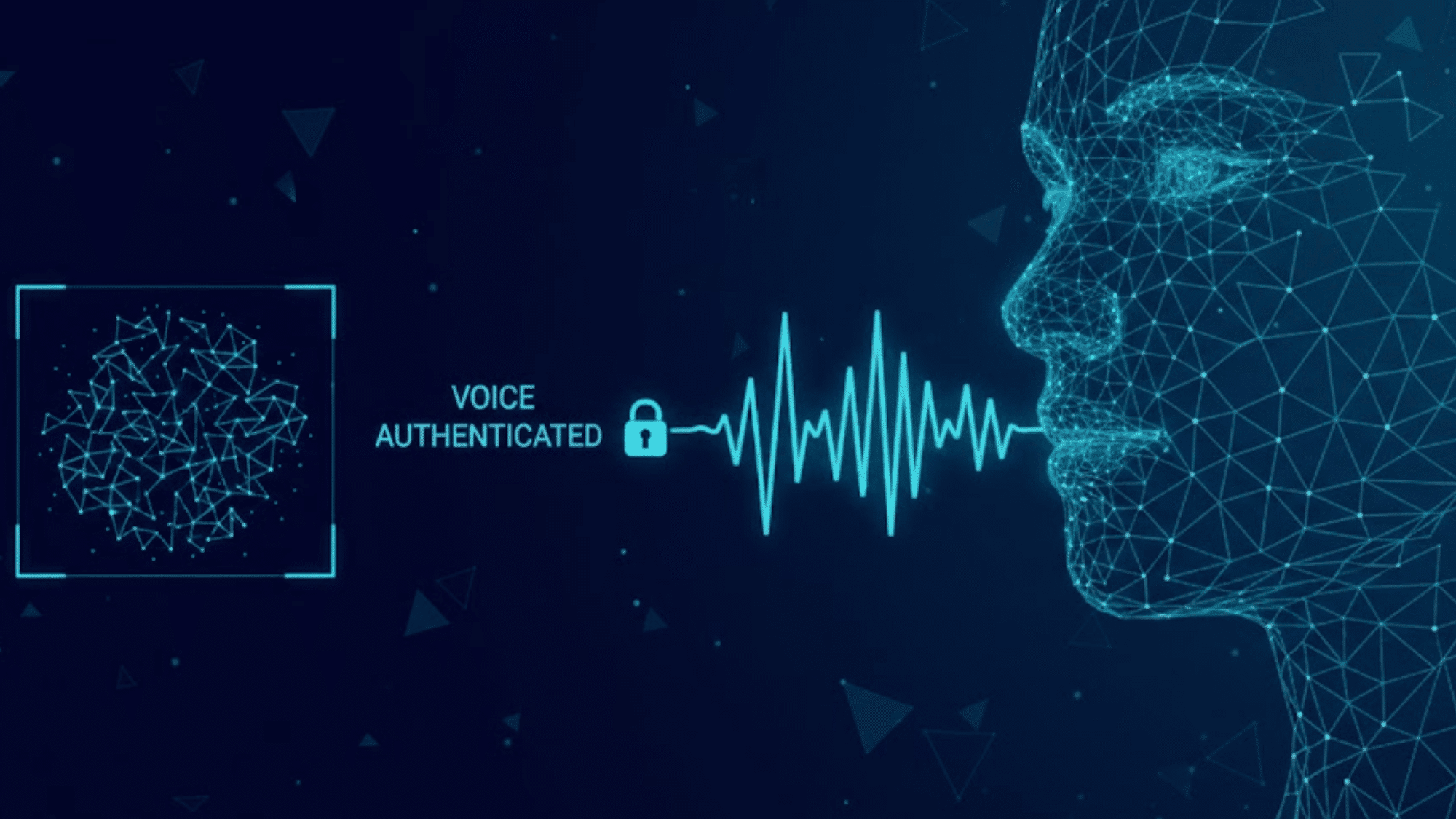
Understanding how voice biometrics works doesn’t require technical expertise. The process is straightforward and happens quickly, often without you even noticing.
Let’s break down each step to see how your voice becomes a secure authentication tool.
Step1: Enrollment
The process starts with enrollment, where the system collects your voice samples. This can happen during a regular phone call with customer service or through a dedicated setup process.
You might be asked to speak a few sentences or simply have a normal conversation. The system records these samples to learn what makes your voice distinctive.
Step 2: Voice Feature Extraction
Once your voice is recorded, the system analyzes it by examining over 100 vocal features like pitch, speed, pronunciation, and physical qualities.
Think of it as the system studying every detail that makes your voice different from everyone else’s.
Step 3: Voiceprint Creation
After analyzing all these features, the system creates your voiceprint, a digital model of your unique vocal identity.
This voiceprint is encrypted and stored securely in a database, much like your fingerprint is stored for security. It’s mathematically complex, which makes it nearly impossible to replicate or steal.
Step 4: Verification & Authentication
When you call back later, the system captures your live voice and compares it against your stored voiceprint. The matching process happens in seconds.
If the vocal characteristics align closely enough, you’re verified and granted access. If there’s a significant mismatch, the system flags it as a potential security issue.
Real-World Example
Imagine calling your bank to check your account balance. Instead of answering security questions, you simply say, “I’d like to check my balance.”
While you’re speaking, the voice biometrics system is already working in the background, comparing your voice to your stored voiceprint.
Within seconds, the system confirms your identity, and the representative can help you, all without asking for your mother’s maiden name or the last four digits of your social security number.
The entire authentication happens naturally during your conversation.
Types of Voice Biometrics Authentication
Voice biometrics isn’t a one-size-fits-all solution. There are two main types, each designed for different security needs and user experiences.
Understanding the difference helps explain why some systems ask you to say specific phrases while others verify you during regular conversation.
Active Voice Biometrics
Active voice biometrics requires the user’s deliberate participation during authentication. You’ll need to speak a predetermined phrase or passphrase that the system recognizes.
Think of it as consciously proving your identity through your voice, similar to entering a password but using speech instead of typing.
Key Features of Active Voice Biometrics:
- Specific Phrase Requirement: Users must say exact words like “My voice is my password” for verification.
- Enhanced Security Control: Works best for sensitive transactions such as wire transfers, account modifications, or high-value operations.
- Deliberate Authentication Step: Creates a clear security checkpoint where users know they’re being verified before proceeding.
- Replay Attack Protection: Random number sequences or changing passphrases prevent fraudsters from using recorded voice samples.
Passive Voice Biometrics
Passive voice biometrics works silently during regular conversations without requiring any special actions.
The system continuously analyzes vocal characteristics while you naturally discuss your needs with customer service or automated systems.
Authentication happens easily in the background, creating an almost invisible security layer that doesn’t interrupt the conversation flow.
Key Features of Passive Voice Biometrics:
- No Memorization Needed: Authentication occurs automatically without recalling or repeating any specific words or phrases.
- Continuous Verification: The system can monitor throughout the entire call, detecting suspicious voice patterns or speaker changes.
- Reduced Call Time: Eliminates lengthy security questions, allowing representatives to assist customers faster and more efficiently.
- Natural User Experience: Callers remain unaware of authentication, making interactions feel smooth, quick, and frustration-free.
Voice Biometrics vs Speech Recognition
Many people confuse voice biometrics with speech recognition because both technologies involve analyzing voices. However, they serve completely different purposes.
Voice biometrics identifies who you are, while speech recognition understands what you’re saying. Here’s a clear breakdown of how these two technologies differ:
| Feature | Voice Biometrics | Speech Recognition |
|---|---|---|
| Primary Focus | Identifies who is speaking based on unique vocal characteristics | Converts spoken words into text or commands |
| Main Purpose | Verifies identity and authenticates users for security | Executes commands and enables voice-controlled interactions |
| What It Analyzes | Physical and behavioral voice traits like pitch and rhythm | The actual words, phrases, and language being spoken |
| Security Role | Acts as a biometric authentication method like fingerprints | Provides convenience but offers no identity verification |
| Common Examples | Bank account access, secure login systems, and fraud prevention | Siri, Alexa, Google Assistant, voice-to-text applications |
| User Action | Speaks naturally or says a passphrase for verification | Issues commands like “play music” or “set a timer.” |
| Technology Goal | Confirms you are who you claim to be | Understands and responds to your spoken instructions |
Understanding the Confusion
When you tell Alexa to play your favorite song, that’s speech recognition interpreting your command.
But when your bank verifies your identity by analyzing your voice, that’s voice biometrics confirming it’s really you calling.
Both technologies can work together; for example, a smart home system might use speech recognition to understand your command and voice biometrics to make sure you’re an authorized user.
How Accurate and Secure Is Voice Biometrics?
Voice biometrics technology has become incredibly reliable, with accuracy rates commonly exceeding 99% in real-world applications.
This high precision means the system rarely mistakes one person’s voice for another, making it a trusted security method across industries.
Organizations use voice biometrics in two main ways: as a standalone authentication tool or as part of multi-factor authentication alongside passwords or security codes.
This flexibility allows businesses to adjust security levels based on their specific needs.
Modern voice biometrics systems include robust protection features. Anti-spoofing technology detects when someone tries to trick the system using recordings or synthesized voices.
Liveness detection ensures the voice sample comes from a real person speaking in real-time, not a playback device.
These systems are constantly updated to defend against emerging threats like deepfake audio, which uses artificial intelligence to mimic voices.
While no security method is completely foolproof, voice biometrics offers strong protection when combined with other security measures and regular system updates.
Benefits of Voice Biometrics
Voice biometrics provides benefits like stronger security and better customer experiences, solving many issues of traditional authentication methods.
Here’s why businesses and customers are embracing voice-based verification.
1. Enhanced Security
Voice biometrics provides a security layer that’s extremely difficult to breach. Unlike passwords that can be guessed, stolen, or shared, your voice is uniquely yours and nearly impossible to replicate perfectly.
Fraudsters can’t easily fake the complex combination of physical and behavioral voice traits the system analyzes.
2. Faster & Convenient Authentication
Nobody enjoys remembering dozens of passwords or answering repetitive security questions. Voice biometrics eliminates this frustration by making authentication as simple as speaking naturally.
The verification process happens in seconds, letting users access their accounts or complete transactions quickly without interrupting their flow.
3. Operational Efficiency
For businesses, voice biometrics translates directly into cost savings and improved productivity. Customer service teams spend less time verifying identities and more time solving actual problems.
This efficiency benefits everyone; companies reduce operational expenses while customers receive faster, more satisfying service.
Limitations and Challenges of Voice Biometrics
While voice biometrics offers impressive benefits, it’s important to understand its limitations. No technology is perfect, and being aware of potential challenges helps set realistic expectations.
Here’s an honest look at the obstacles voice biometrics faces:
| Challenge | Description | Mitigation Strategies |
|---|---|---|
| Background Noise | Environmental sounds, such as traffic or conversations, interfere with voice analysis, reducing accuracy. | Noise-canceling algorithms filter ambient sounds; systems adapt to different environments |
| Temporary Voice Changes | Illness, stress, or fatigue alter voice characteristics, potentially causing authentication failures | Fallback authentication methods available; flexible matching thresholds during verification |
| Aging Effects | Natural voice changes over time affect pitch and tone, making stored voiceprints outdated | Regular voiceprint updates; systems gradually adapt through continuous learning algorithms |
| Deepfake Audio | AI-generated synthetic voices can mimic real people with increasing accuracy | Liveness detection verifies real-time speech; anti-spoofing analyzes audio for synthetic artifacts |
| Privacy Concerns | Users worry about voice data storage, usage, and potential unauthorized access | Encryption safeguards voiceprints, policies, and GDPR compliance. |
Voice biometrics improve to tackle challenges, combining multiple security layers with backup methods for user access, even if voice verification fails.
Is Voice Biometrics Safe and Legal?
Voice biometrics is both safe and legal when implemented properly. Reputable companies follow strict data protection standards to keep voiceprints secure through encryption, making them nearly impossible to steal or misuse.
Your voice data is converted into mathematical patterns rather than stored as actual recordings, adding another security layer.
Legally, organizations must obtain clear user consent before collecting voice samples. Most companies explain how they’ll use your voice data and give you the option to opt in or out.
Voice biometrics systems comply with major security standards and privacy regulations like GDPR in Europe and various state laws in the United States.
While concerns about voice data are understandable, established providers treat voiceprints with the same care as other sensitive biometric information, using industry-standard protections to prevent unauthorized access.
Wrapping It Up
Voice biometrics represents a significant shift in how we approach security and authentication. This technology delivers both robust fraud prevention and effortless user convenience, a combination that’s hard to beat.
From banking to customer service, voice biometrics is already changing how millions access their accounts daily.
While challenges like background noise and deepfakes exist, ongoing improvements in liveness detection and anti-spoofing make systems increasingly reliable.
As passwords become less effective against modern threats, biometric solutions like voice authentication will play an even larger role in securing our digital future.
Ready to strengthen your authentication strategy? Learn how voice biometrics can protect your business while delighting your customers.