







Wondering what you can actually earn in cybersecurity? You’re not alone. Even if you’re thinking about breaking into the field or trying to figure out if your current pay is fair, salary numbers seem to be all over the place.
The truth is, a cybersecurity salary depends on a bunch of factors, including your job title, how many years you’ve been doing this, where you live, and even which certifications you have.
This guide will walk you through the real numbers. You’ll see what entry-level positions pay, how much mid-level and senior roles earn, and which cities offer the highest salaries.
We’ll also cover the certifications and skills that can boost your paycheck, plus tips from people already working in the field.
By the end, you’ll know exactly what to expect and how to plan your path forward.
Cyber Security Salary Range by Experience Level
These ranges give a quick picture of how pay grows across the cybersecurity job market, from entry-level jobs to leadership roles.
Entry-level cyber security salary (0–2 years)
When you’re just starting out, you’ll likely land titles like SOC Analyst, Junior Security Analyst, or Security Administrator.
Your first offer depends on internships, lab experience, certifications like Security+, location, and willingness to work night or weekend shifts, which may pay more.
Typical range: $60,000 – $85,000
Mid-level cyber security salary (3–6 years)
After a few years, you’ll move into roles like Security Engineer, Incident Responder, or Cloud Security Associate.
This is where pay really jumps because you’re not just following procedures anymore, you’re owning entire systems, being on-call for emergencies, leading incident response efforts, and building automation that saves the team time.
Typical range: $90,000 – $130,000
Senior cyber security salary (7–10+ years)
With serious experience, you’ll step into positions like Security Architect, Security Manager, or Staff/Principal Engineer. At this level, remember that your total compensation matters just as much as your base salary.
Bigger tech companies and competitive markets often throw in significant bonuses and equity (stock options) on top of your base pay.
Typical range: $130,000 – $200,000+ (base salary)
Your title matters less than what you actually do; responsibilities and proven skills move your salary faster than years alone.
Cyber Security Salary by Role
Different job titles come with different paychecks. Here’s what the most common cybersecurity roles actually pay across the country.
| Role | What They Do | Typical Base Range | Skills That Raise Pay |
|---|---|---|---|
| Cybersecurity Analyst | Monitor networks, investigate alerts, and respond to incidents | $70,000 – $110,000 | SIEM tools, threat intel, Python, incident response |
| Cybersecurity Engineer | Build security systems, configure firewalls, automate defenses | $95,000 – $140,000 | Cloud security, automation, IAM, DevSecOps |
| Penetration Tester | Test for vulnerabilities, simulate attacks, write reports | $85,000 – $135,000 | Exploitation, web app security, scripting |
| Information Security Manager | Lead teams, set strategy, manage compliance | $120,000 – $175,000 | Leadership, risk management, NIST/ISO frameworks |
| Security Architect | Design security systems, plan a strategy, and choose tools | $140,000 – $210,000+ | Enterprise architecture, zero-trust, cloud design |
The Cybersecurity Analyst role aligns closely with the Bureau of Labor Statistics’ “Information Security Analyst” benchmark of $124,910 median salary.
Pick a role that matches your strengths, technical depth, people leadership, or strategic thinking, and your earning potential follows naturally.
Here’s the section with connecting line, table, and outro:
Cyber Security Salary by Location
Certain cities consistently offer higher cybersecurity salaries. Here’s where the money tends to be best:
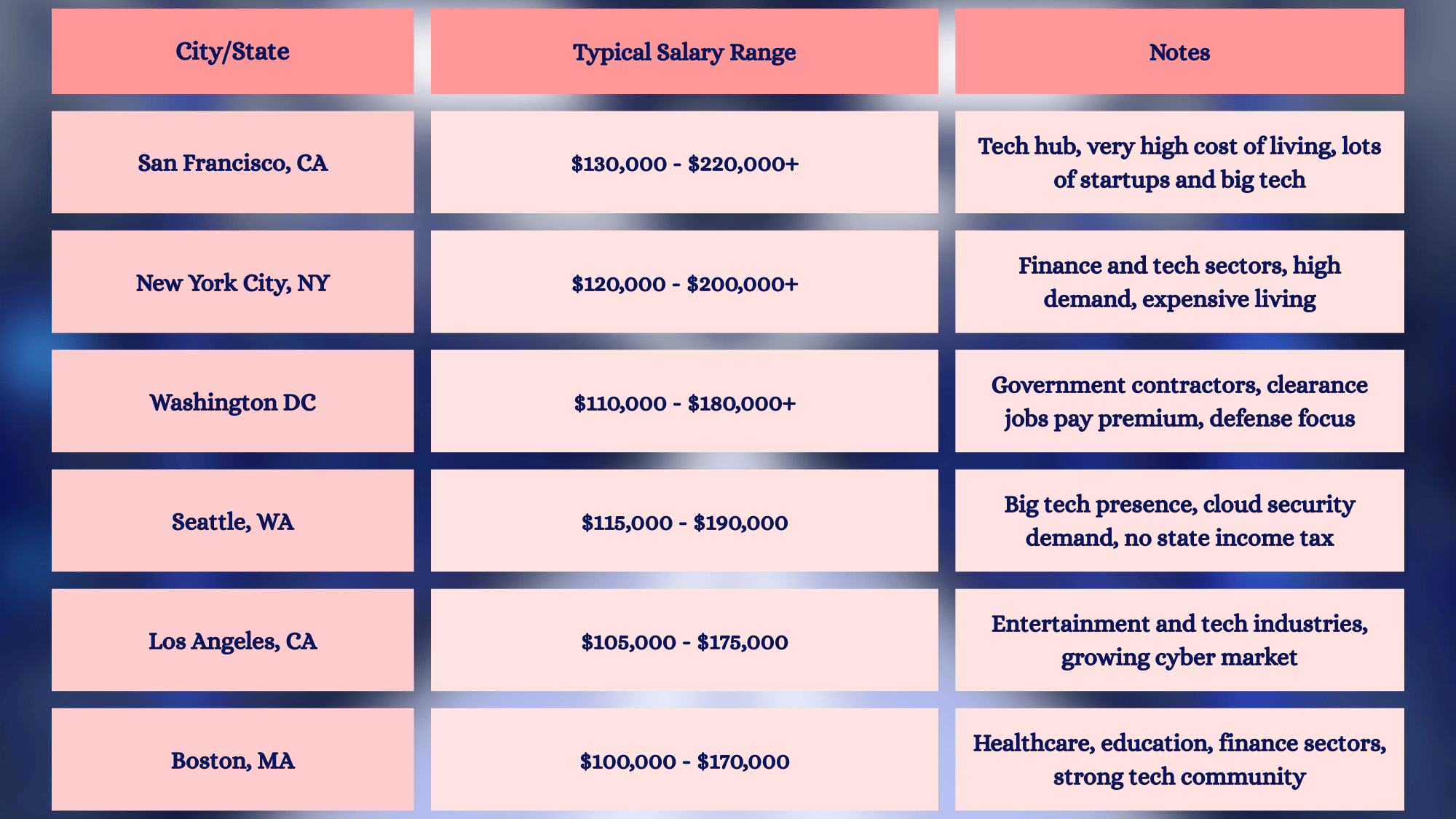
Why Location Changes Pay
Where you work has a huge impact on your paycheck. Dense tech hubs like San Francisco or New York pay more because living there costs more and companies compete hard for talent.
But remote work is changing the game; some companies now hire from anywhere and adjust pay based on where you live.
Remote vs Hybrid vs Onsite Pay
Here’s where it gets tricky. Some companies pay “national bands”, meaning everyone doing the same job gets the same salary, no matter where they live.
Others adjust your pay based on your home location. A Security Engineer in San Francisco might make $150,000, while the same role for a remote worker in Ohio pays $110,000 at the same company.
Your location directly shapes your offer, but remote cybersecurity jobs work is slowly evening out the gaps across different cities and states.
What Changes Your Cyber Security Salary the Most

Cybersecurity salaries can look confusing at first. One person earns $70,000, while another with the same title earns $140,000.
The reason is simple: pay changes based on skills, certifications, industry, and even who the employer is. Below are the biggest factors that cause salary numbers to be all over the place.
1. Certifications That Can Raise Pay
Certifications often help open better-paying roles, especially after some hands-on experience. Employers see them as proof of commitment and baseline knowledge.
Common certifications and where they help most
| Certification | Best for roles like | Salary impact |
|---|---|---|
| CompTIA Security+ | Entry-level analyst, SOC roles | Small to moderate boost |
| CEH (Ethical Hacker) | Pen tester, red team | Moderate boost |
| CISSP | Senior engineer, architect, manager | Strong boost |
| GIAC (GSEC, GCIH, etc.) | DFIR, blue team, IR | Strong boost |
Certifications help, but proof of skills wins every time. Someone who can show real projects, lab work, or incident experience often earns more than someone with only certificates.
2. Skills That Usually Pay Extra
Some cybersecurity skills are in higher demand and come with higher pay. These skills are harder to learn and are used in real attacks and defenses.
High-paying skill areas
- Cloud security (AWS, Azure, GCP)
- IAM (identity and access management)
- Detection engineering (writing alerts, tuning SIEM rules)
- SIEM tools (Splunk, Sentinel, QRadar)
- Incident response and forensics
- Threat intelligence
- Application security (AppSec)
Skills that reduce risk, stop attacks faster, or protect cloud systems usually get paid more than basic monitoring work.
3. Industry and Company Type
Not all industries pay the same, even for the same job title.
How pay differs by industry
- Finance & Fintech: Often high pay, high pressure
- Healthcare: Medium pay, strong job stability
- Defense & Government: Stable pay, slower growth
- Big Tech: High base pay plus bonuses and stock
- Startups: Lower base pay, possible equity upside
Larger companies usually offer higher total pay, while smaller companies may offer learning opportunities instead of high salaries.
4. Clearance and Government Contracting
Security clearance can increase salary in some roles, but it depends on location and job type.
What to know about cleared roles
- Most common in defense and government contracting
- Higher pay in areas like DC, Virginia, and Maryland
- Less useful in commercial or startup roles
- Often comes with on-site work requirements
- Clearance can raise pay, but it also limits job flexibility. It works best for people planning long-term careers in government or defense-focused roles.
Cyber security salary changes because not all experience is equal. Skills, real-world impact, certifications, and industry matter more than job titles alone.
What People Say About Cyber Security Salaries
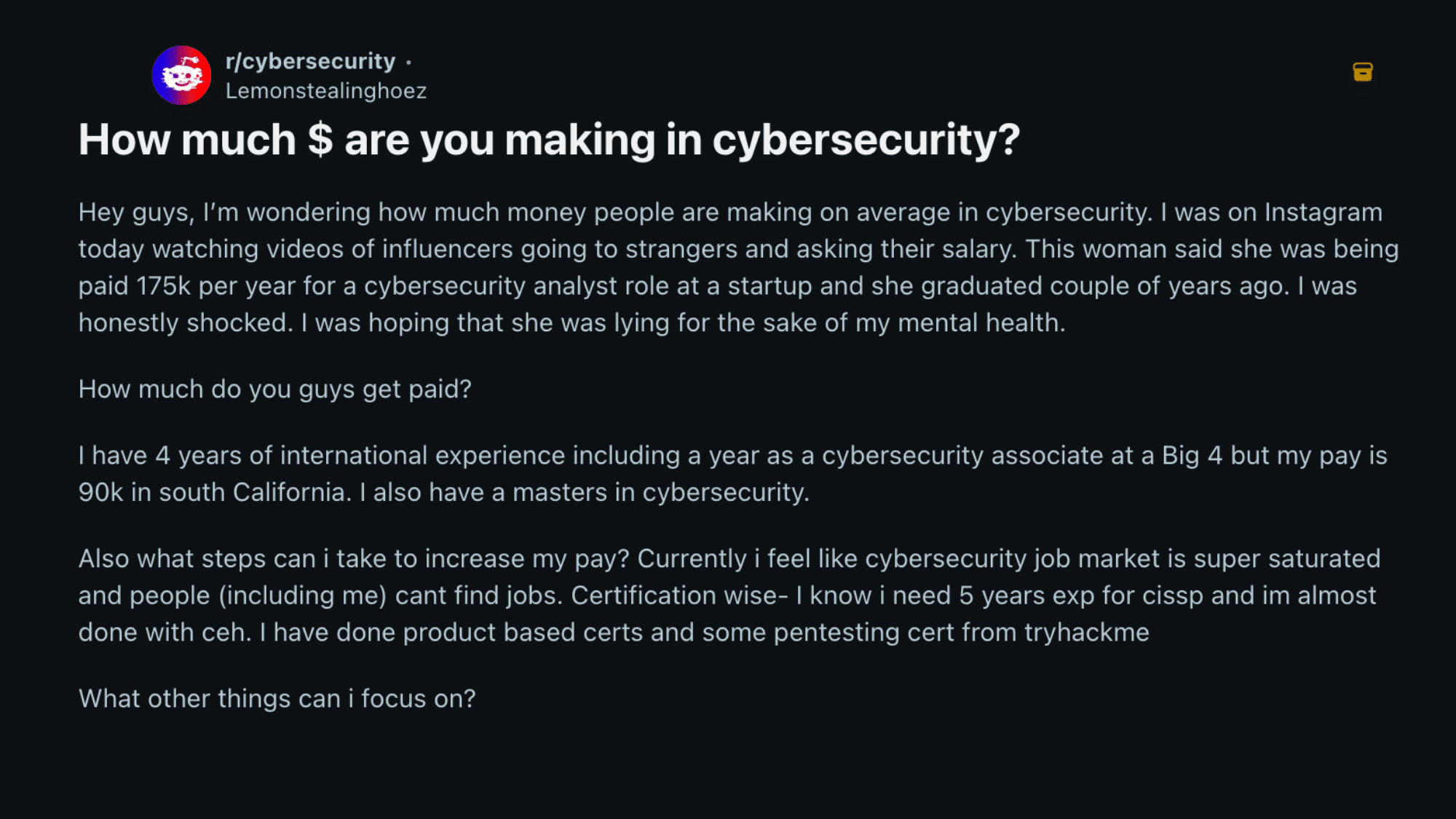
Cybersecurity salary posts online can feel like a roller coaster. Some numbers look huge, while others seem surprisingly low.
The truth is that pay depends on skills, location, and what the job really includes. Here’s the kind of honest talk often shared in community threads and chats.
One person on Reddit said:
“Started as a SOC analyst at $68k in a mid-sized city. Two years later, after getting better at SIEM tuning and incident response, the jump to $98k felt realistic. The big change wasn’t the title, it was being able to handle real incidents without hand-holding.”
You can also join and share your thoughts here on Reddit.
How to Negotiate a Higher Cyber Security Salary
Negotiating pay can feel uncomfortable, but it matters. Many cybersecurity professionals leave money on the table simply because they do not ask.
A good negotiation is not about demanding more. It is about showing value and knowing what is fair for the role.
What to Research Before Negotiating
Walking into a salary discussion without research is risky. Numbers give confidence and help keep the conversation realistic.
Key things to check first
- Average cybersecurity salary for the exact role
- Pay range for the city or state (location bands matter)
- Seniority or level (junior, mid, senior, lead)
- Company size and industry standards
Helpful comparison points
| Factor | Why It Matters |
|---|---|
| Location | High-cost areas usually pay more |
| Leveling | “Senior” can mean different things |
| Company size | Big firms often pay a higher base |
| Industry | Finance and tech often pay more |
Having a clear range makes it easier to ask for a fair number.
How to Talk About Impact (Not Just Duties)
Salary talks work better when focused on results, not job tasks. Employers pay more for impact.
Strong impact examples
- Security incidents handled or reduced
- Systems hardened or risks removed
- Tools or controls shipped into production
- Time saved through automation
- Compliance gaps closed before audits
Simple way to frame it
- “This change reduced alert noise by 40%.”
- “That control lowered response time by hour.s”
- “This process prevented repeat inciden.ts”
Clear results make the salary request feel earned, not emotional.
What to Negotiate Besides Base Pay
Base salary is important, but it is not the only lever. Many offers have room to improve total value.
Common items worth negotiating
- Annual bonus
- Stock or equity
- Signing bonus
- Training or certification budget
- Remote or hybrid work options
- Job title or level (can affect future pay)
Bottom line: good negotiation is about preparation, proof, and options. Knowing the market, showing real impact, and looking beyond base pay can lead to a much stronger cybersecurity salary.
Final Thoughts
Cybersecurity salaries can grow fast, but the best results usually come from smart choices, not luck. The biggest pay jumps often happen when strong skills are built, real work is shown, and the right roles are targeted.
Certifications can help, but hands-on experience and clear impact matter even more. Location, industry, and job level also change the numbers a lot, so comparing salaries only by title can be misleading.
Keep watching the market, keep learning, and stay ready to negotiate when a better opportunity shows up.
Want a more accurate estimate? Share the role, experience level, and city, and a realistic salary range can be mapped out.
Frequently Asked Questions
Is Cybersecurity a Stressful Career?
Cybersecurity can be stressful during active threats or data breaches, but many professionals enjoy the fast-paced and problem-solving nature of the work.
Do Cybersecurity Jobs Require Coding Skills?
Not every role requires coding, but knowing Python, PowerShell, or scripting basics can help you qualify for higher-paying positions.
Can Someone Switch to Cybersecurity from Another Career?
Yes, many people move into cybersecurity from IT support, networking, software development, or even non-technical backgrounds, gaining experience through certifications and training.
Is a College Degree Required for Cybersecurity Jobs?
Many employers value hands-on skills, certifications, and real-world projects just as much as, or more than, a traditional degree.
Which Cybersecurity Field Is Expected to Grow the Most?
Cloud security and AI-related security roles are expected to grow quickly as businesses rely more on cloud platforms and automated systems.