



Businesses generate massive amounts of data every second from sensors, cameras, machines, mobile devices, and connected systems.
For faster decisions, this data often needs instant analysis instead of cloud processing.
By combining artificial intelligence with edge computing, organizations can process and analyze data closer to where it is created.
This allows systems to identify patterns, detect issues, and respond to events in real time.
Edge AI is helping organizations improve efficiency, reduce delays, and gain faster insights.
This guide explains how Edge AI for real-time analytics works, its benefits, common use cases, and the challenges businesses should consider before implementation.
What Is Edge AI for Real-Time Analytics?
Edge AI for real-time analytics refers to the use of artificial intelligence models on edge devices to process and analyze data in real time.
Instead of sending information to a centralized cloud server for analysis, the data is processed locally on devices such as sensors, cameras, gateways, smartphones, or industrial equipment.
This approach allows systems to generate insights and make decisions almost instantly.
Real-time analytics powered by Edge AI can identify patterns, detect anomalies, predict outcomes, and automate responses without relying entirely on cloud connectivity.
Organizations use it to monitor equipment, improve customer experiences, enhance security systems, and support intelligent automation.
As connected devices continue to generate larger volumes of data, Edge AI is becoming an increasingly important technology for delivering fast, efficient, and reliable analytics.
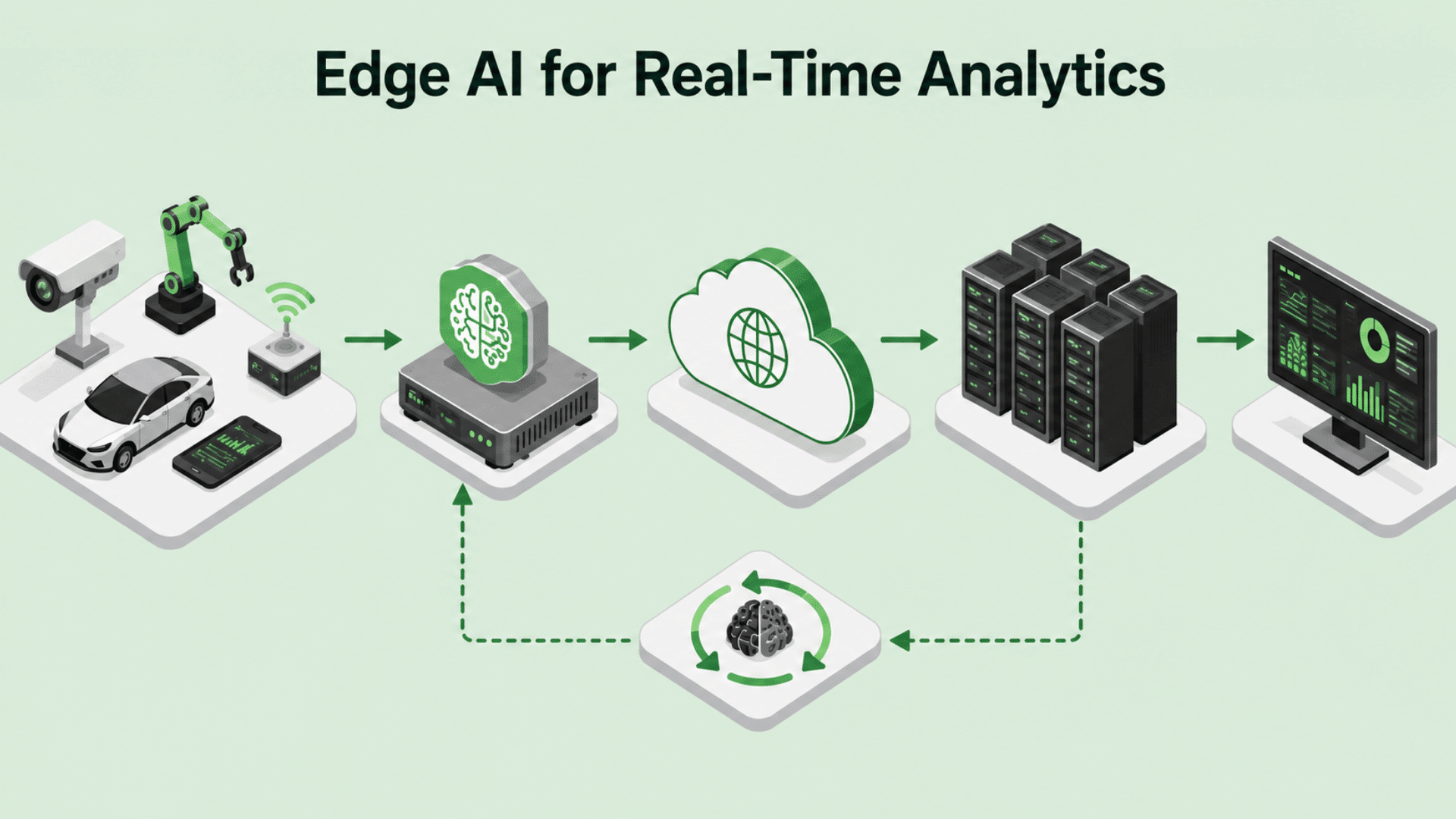
How Does Edge AI for Real-Time Analytics Work?
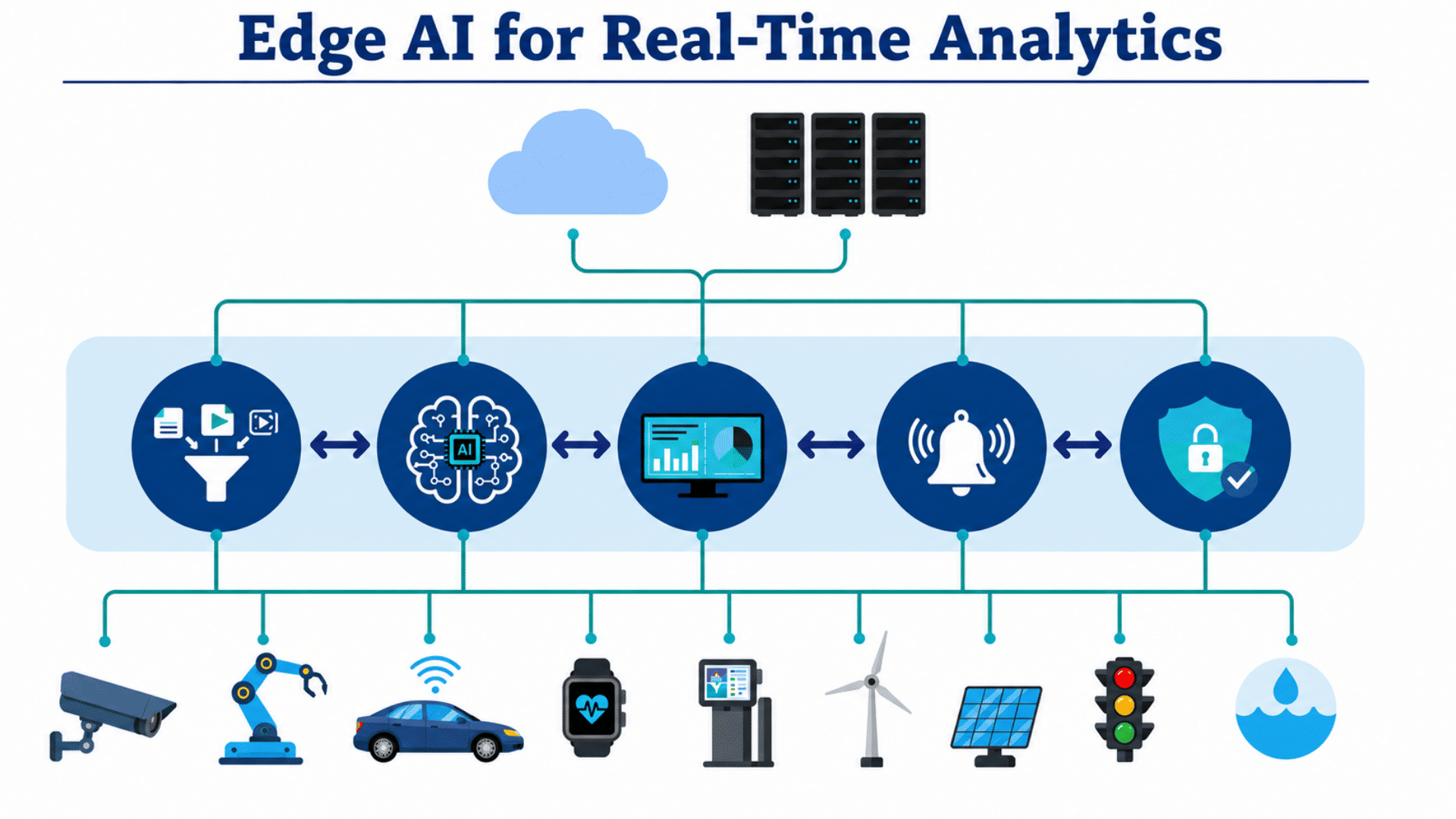
Instead of sending large amounts of data to a centralized cloud platform, edge devices analyze the information locally and deliver insights almost instantly.
1. Data Collection at the Edge
The process begins when edge devices collect data from sensors, cameras, machines, smartphones, or other connected systems.
Rather than transmitting every piece of data to the cloud, the information is captured and prepared for local processing.
This allows organizations to begin analyzing data closer to its source and reduce unnecessary network traffic.
Data collection at the edge is especially valuable in environments that generate large volumes of information every second.
By filtering and organizing data before analysis, edge systems can improve efficiency and ensure that only relevant information is processed.
2. Local Data Processing
Once data is collected, the edge device processes it close to the source. This reduces the need to transfer large volumes of information across networks.
Local processing can help lower bandwidth usage, improve response times, and reduce dependence on internet connectivity.
It also allows organizations to analyze data in remote environments where network access may be limited or unreliable.
Because processing occurs near the data source, systems can continue operating even when cloud connectivity is interrupted.
This makes local processing particularly useful for industrial facilities, transportation networks, and other mission-critical environments.
3. AI Model Inference
After processing the data, AI models running on the edge device analyze the information and generate predictions or insights.
These models can identify patterns, detect anomalies, classify objects, and support decision-making.
Since the analysis occurs locally, results can be produced much faster than cloud-based processing. This enables organizations to gain immediate insights and respond to events as they occur.
AI model inference is a key component of Edge AI because it transforms raw data into actionable information.
4. Real-Time Decision Making
The final step is taking action based on the insights generated by the AI model.
The system can automatically trigger alerts, adjust machine settings, identify security threats, or respond to changing conditions.
Real-time decision-making helps organizations improve efficiency, reduce risks, and react quickly to important events.
In many applications, rapid decision-making can improve safety, reduce operational costs, and prevent minor issues from becoming larger problems.
As a result, organizations can respond more effectively while maintaining higher levels of performance and reliability.
Core Technologies Behind Edge AI
Edge AI combines several technologies that enable devices to process and analyze data locally in real time.
| Technology | Role in Edge AI |
|---|---|
| Edge Devices | Collect and process data close to its source. |
| AI/ML Models | Analyze data and generate predictions or decisions locally. |
| IoT Sensors | Capture real-time information from connected environments. |
| Edge Processors (CPU/GPU/NPU) | Provide computing power for on-device AI inference. |
| Computer Vision | Enables image and video analysis on edge devices. |
| 5G and Wi-Fi | Support fast communication between edge devices and cloud systems. |
| Cloud Platforms | Train AI models, store data, and distribute model updates. |
Why Does Real-Time Analytics Need Edge AI?
Edge AI enables real-time analytics by processing data close to where it is generated, reducing delays and improving responsiveness.
- Reduces Latency: Processing data locally minimizes delays, enabling systems to analyze information and respond almost instantly without cloud communication bottlenecks.
- Supports Faster Decisions: Immediate local analysis helps devices trigger alerts, automate actions, and respond quickly to changing conditions in real time.
- Saves Network Bandwidth: Only essential insights are transmitted to cloud servers, reducing network traffic and significantly lowering communication and storage costs.
- Improves Reliability: Edge AI continues processing data even during limited or unstable internet connectivity, ensuring uninterrupted real-time analytics and operations.
- Enhances Data Privacy: Keeping sensitive information on local devices reduces unnecessary data transfers and supports stronger privacy and security practices effectively.
- Scales Connected Devices: Edge AI efficiently handles growing numbers of IoT devices without overwhelming centralized cloud infrastructure or network resources.
Key Benefits of Edge AI for Real-Time Analytics
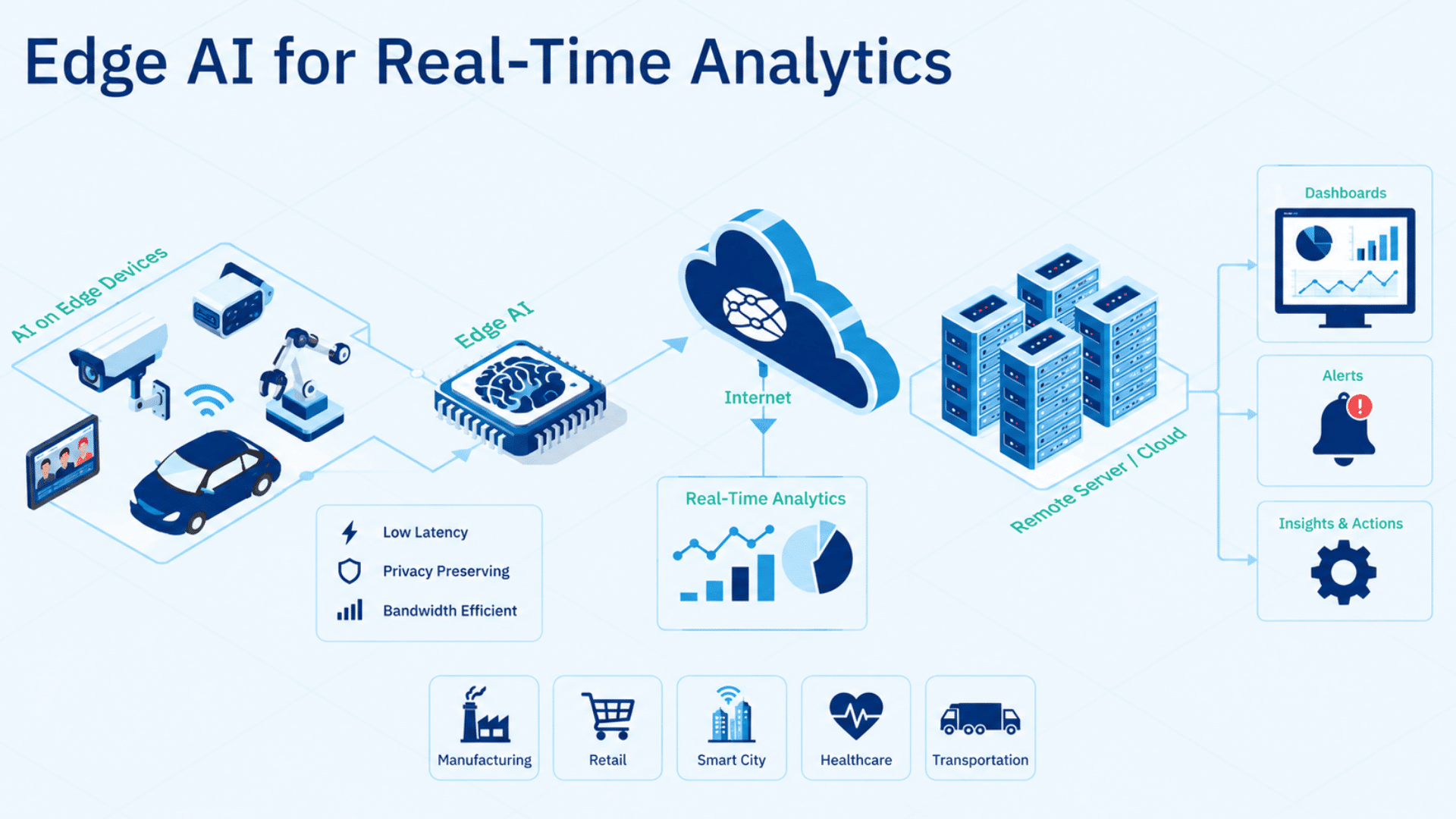
Edge AI enables faster data processing, lower latency, improved privacy, reduced bandwidth usage, and reliable real-time decision-making across connected systems.
1. Faster Response Times
One of the biggest advantages of Edge AI is its ability to deliver faster response times. Since data is processed on local devices rather than being sent to a remote cloud server, insights can be generated almost instantly.
This is especially important in environments where rapid action is required, such as manufacturing, healthcare, and transportation.
This can improve operational efficiency, enhance customer experiences, and reduce the risk of delays in critical processes.
In time-sensitive applications, even a small improvement in response speed can significantly impact performance and outcomes.
2. Reduced Latency
Latency refers to the delay between data generation and analysis. Traditional cloud-based analytics may experience delays due to network transmission and processing time.
Edge AI reduces latency by performing computations closer to the data source. This allows systems to analyze information and respond in real time.
Lower latency is particularly valuable for applications such as autonomous vehicles, surveillance systems, and industrial automation, where delays can impact performance or safety.
This capability is one of the primary reasons many businesses are adopting Edge AI solutions.
3. Lower Bandwidth Usage
Transferring large amounts of data to the cloud can consume significant network bandwidth.
Edge AI helps reduce bandwidth requirements by processing much of the data locally and sending only relevant insights or summarized information to central systems.
This approach can lower communication costs and improve overall network efficiency.
Reducing bandwidth usage is especially beneficial for organizations that manage large numbers of connected devices or operate in locations with limited network capacity.
It also helps organizations handle growing data volumes more efficiently as edge computing deployments continue to expand.
4. Improved Data Privacy
Many organizations handle sensitive information that requires strong privacy protection. Edge AI supports data privacy by keeping much of the processing on local devices rather than transmitting raw data across networks.
This approach reduces exposure to potential security risks and limits the amount of sensitive information shared with external systems.
By processing data closer to its source, organizations can maintain greater control over how information is collected, stored, and analyzed.
Industries such as healthcare, finance, and government services often benefit from this added level of security and data control while still gaining access to real-time insights.
5. Greater Reliability
Edge AI can continue operating even when internet connectivity is limited or unavailable.
Because analysis occurs locally, systems do not always depend on constant access to cloud services.
This makes Edge AI a reliable option for remote locations, industrial sites, and critical operations where uninterrupted performance is important.
Greater reliability helps ensure that analytics and decision-making processes continue running when they are needed most.
Top Use Cases of Edge AI for Real-Time Analytics
Organizations across many industries use Edge AI to analyze data instantly and improve operational efficiency. Some of the most common use cases include:
- Smart Manufacturing: Monitor equipment performance, detect defects, support predictive maintenance, and reduce production downtime through real-time analysis.
- Healthcare Monitoring: Analyze data from medical devices and wearables to detect abnormal conditions quickly and support faster patient care decisions.
- Retail Analytics: Track customer behavior, monitor inventory levels, optimize store layouts, and improve shopping experiences through real-time insights.
- Autonomous Vehicles: Process data from cameras, sensors, and radar systems to support real-time navigation, obstacle detection, and driving decisions.
- Smart Cities: Improve traffic management, public safety, environmental monitoring, and infrastructure operations using connected sensors and AI-powered analytics.
- Industrial IoT: Monitor connected machines, improve energy efficiency, support predictive maintenance, and respond to operational events as they occur.
- Agriculture: Edge AI on field sensors and drones analyzes soil moisture, crop health, and weather data in real time, enabling precise irrigation and early detection of disease or pest damage without requiring constant connectivity to a cloud server.
Edge AI vs Cloud-Based Analytics
While both approaches offer valuable analytics capabilities, Edge AI is often preferred when organizations need immediate insights and rapid decision-making.
| Feature | Edge AI | Cloud-Based Analytics |
| Data Processing Location | Near the data source | Centralized cloud servers |
| Response Time | Near real-time | May experience network delays |
| Latency | Low | Higher due to data transmission |
| Bandwidth Usage | Lower | Higher |
| Internet Dependency | Can operate with limited connectivity | Requires stable internet access |
| Data Privacy | More data remains local | Data is sent to cloud platforms |
| Reliability | Continues operating during network issues | Performance may be affected by connectivity problems |
| Best Use Cases | Time-sensitive applications | Large-scale data storage and analysis |
What are the Challenges of Implementing Edge AI?
While Edge AI offers many benefits, organizations may face several challenges during implementation:
- Limited Hardware Resources: Edge devices often have less processing power and storage than cloud servers.
- Deployment Costs: Upgrading devices and infrastructure can require significant investment.
- Model Management: AI models must be updated and maintained across multiple edge devices.
- Security Risks: Connected edge devices can become potential targets if security measures are not properly implemented.
- Scalability Challenges: Managing large networks of edge devices may become more complex as deployments grow.
- Data Consistency: Maintaining accurate and synchronized information across devices can require additional management.
Future of Edge AI for Real-Time Analytics
The future of Edge AI for real-time analytics looks promising as organizations continue to generate larger amounts of data from connected devices.
Advances in AI models, edge hardware, and network technologies are making it easier to process information closer to the source while maintaining high levels of performance.
5G expansion is expected to strengthen Edge AI with faster device and system communication.
At the same time, more powerful edge processors are enabling complex AI workloads to run locally without relying heavily on cloud infrastructure.
Businesses are also expected to use Edge AI in healthcare, retail, transportation, and smart city projects.
As technology continues to evolve, Edge AI will play an increasingly important role in delivering real-time insights, improving automation, and helping organizations make faster, data-driven decisions.
Popular Edge AI Platforms and Frameworks
Several platforms and frameworks help developers build, deploy, and manage AI applications on edge devices.
| Platform/Framework | Primary Use |
|---|---|
| TensorFlow Lite | Runs lightweight AI models on mobile and edge devices. |
| NVIDIA Jetson | Develops and deploys AI applications for robotics and embedded systems. |
| OpenVINO | Optimizes AI inference on Intel CPUs, GPUs, and edge hardware. |
| ONNX Runtime | Runs AI models efficiently across multiple hardware platforms. |
| AWS IoT Greengrass | Extends AWS cloud services to edge devices for local processing. |
| Azure IoT Edge | Deploys AI workloads and cloud services to edge devices. |
| Google Coral | Accelerates on-device AI inference using Google’s Edge TPU hardware. |
| Edge Impulse | Builds and deploys machine learning models for embedded and IoT devices. |
Best Practices for Successful Edge AI Deployment
A well-planned deployment helps organizations maximize Edge AI performance, reliability, security, and long-term scalability.
- Choose Suitable Hardware: Select edge devices with sufficient processing power, memory, and AI acceleration to efficiently and reliably support application requirements.
- Optimize AI Models: Compress and optimize machine learning models to improve inference speed while effectively minimizing resource consumption on edge devices.
- Strengthen Security: Protect devices using encryption, secure authentication, regular updates, and access controls to reduce cybersecurity risks and unauthorized access.
- Ensure Reliable Connectivity: Maintain stable network connections for model updates, centralized management, and cloud synchronization without affecting local processing capabilities.
- Monitor System Performance: Continuously track device health, AI accuracy, and operational metrics to identify issues and consistently improve long-term deployment performance.
- Plan for Scalability: Design infrastructure that supports adding more edge devices, workloads, and AI models without compromising system performance or reliability.
- Run Pilot Deployments First: Before scaling across an entire facility or device fleet, test the edge AI setup in a controlled environment. Pilot projects surface unexpected hardware incompatibilities, model accuracy gaps, and network issues at a manageable scale.
Conclusion
Edge AI for real-time analytics is helping organizations process data faster, reduce latency, and make quicker decisions closer to where information is generated.
Edge AI helps businesses analyze data locally instead of relying only on cloud processing.
From manufacturing and healthcare to retail and smart cities, Edge AI supports a wide range of applications that require immediate insights and rapid responses.
Its ability to improve efficiency, reduce bandwidth usage, and enhance reliability makes it an attractive solution for modern organizations.
Businesses that adopt this technology can gain faster insights and improve operational performance. Read more technology guides to stay updated on emerging AI and edge computing trends.
Frequently Asked Questions
What Devices Can Run Edge AI Applications?
Edge AI can run on devices such as sensors, cameras, smartphones, gateways, industrial equipment, and other connected systems with processing capabilities.
Does Edge AI Require Cloud Connectivity?
No. Many Edge AI systems can process and analyze data locally, allowing them to continue operating even when internet connectivity is limited.
Can Small Businesses Use Edge AI Solutions?
Yes. Many modern Edge AI solutions are scalable and can be implemented by businesses of different sizes depending on their operational needs.