



Cloud offers operational savings, speed, and scale, but its price tag isn’t straightforward.
The cost of moving to the cloud is complex, and many organizations only realize the full picture after making significant commitments.
Licensing surprises, data transfer fees, modernization complexity, and underestimated professional services costs are common gaps between budgeted and actual spending in post-migration reviews.
The organizations that manage this well do not have smaller projects; they have better information going in.
This guide breaks down all cost categories, including those missed by providers, to help your team build a reliable budget.
Budgeting in isolation often misses the broader scope of what cloud transformation actually involves.
A realistic cloud budget also depends on understanding long-term operational impact, not just the upfront migration expense.
Why Are Cloud Cost Estimates Often Inaccurate?
The gap between early estimates and actual invoices is rarely due to overspending; it is due to undercounting what the project actually includes from the start.
Most early-stage cloud cost estimates rely on one flawed assumption: that existing systems will move with minimal change. In practice, lift-and-shift is rarely as clean as it looks on paper.
Hidden dependencies inflate scope. Applications designed for on-premises hardware perform poorly in the cloud without tuning.
Licensing models that worked in a data center create unexpected charges when workloads run in the cloud.
Organizations that skip the discovery and assessment phase consistently reprice mid-project, when course correction is expensive, and deadlines are already set.
Flexera’s 2024 State of the Cloud Report found that organizations waste an estimated 28% of cloud spend, a figure that rises significantly for teams without FinOps practices in place before migration begins.
Cost Categories when Moving to the Cloud
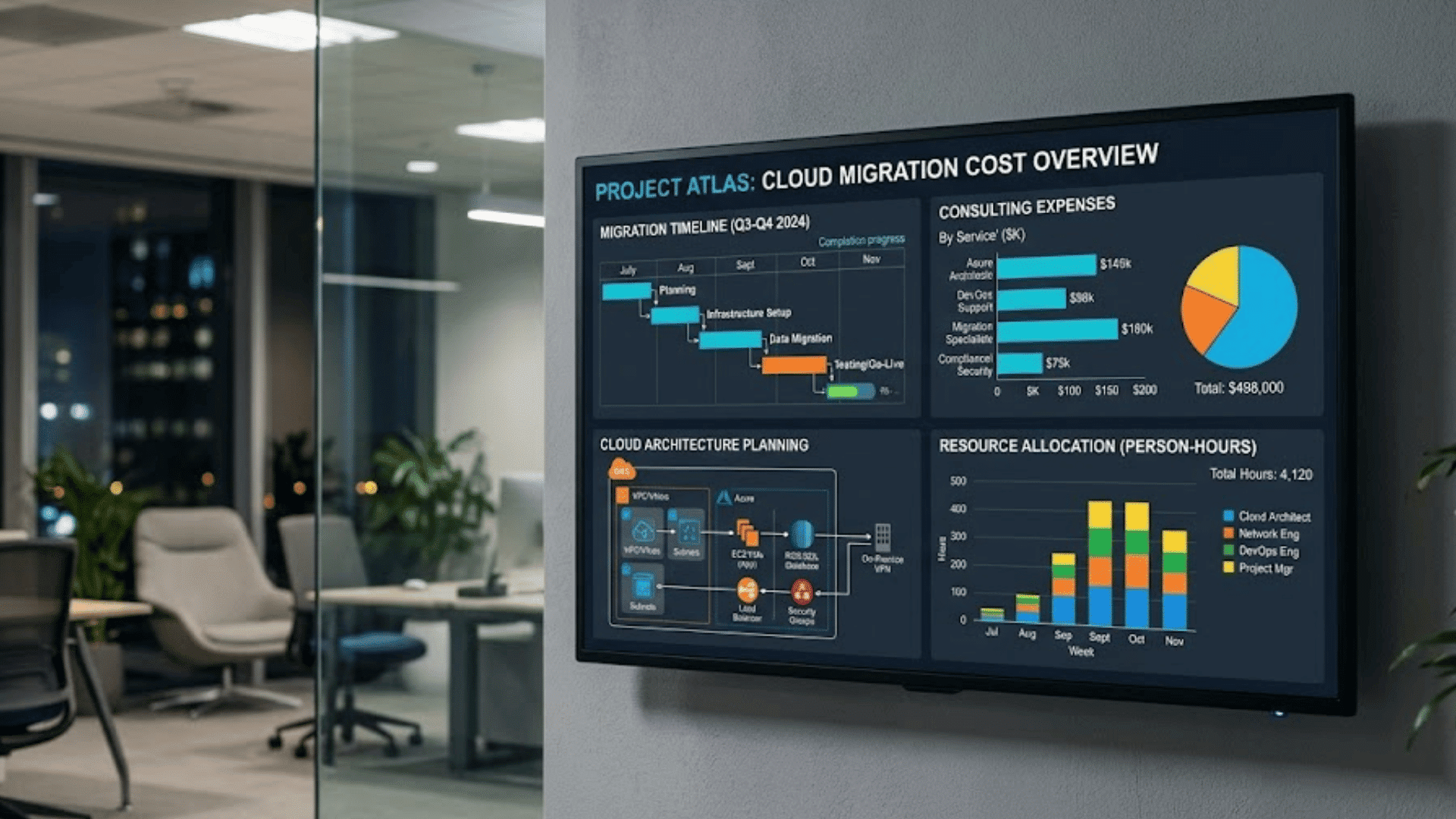
Each category below represents a distinct line item in a complete migration budget, and most teams account for only three or four of them in their initial planning.
1. Migration and Professional Services
These are the costs most teams plan for, but their scope is frequently underestimated, especially when internal time is excluded from the calculation.
Assessment and architecture fees, partner delivery costs, and project management overhead all belong here.
What often goes unaccounted is internal team time: the engineers, architects, and security reviewers who are partially reassigned from other work during the migration.
That opportunity cost is measurable and real, even if it does not appear on a vendor invoice.
Organizations that exclude it from budget models end up with delivery gaps that cannot be filled without delay or scope reduction.
Useful Detail:
- Internal team time during migration typically accounts for 20–35% of total project cost in organizations without deep cloud expertise.
- AWS Migration Acceleration Program (MAP) offers credits and co-funding for qualifying migrations through certified AWS partners, worth evaluating before signing a fixed-price contract.
2. Infrastructure and Compute
Cloud compute costs look predictable in a pricing calculator, but behave differently once production workloads are running and usage patterns become visible.
On-demand pricing during early phases leads to significant overprovisioning as teams buffer for uncertainty.
Storage costs scale with data volume and access frequency in ways that on-premises fixed-capacity systems do not.
Network egress charges, fees for moving data out of the cloud, are consistently one of the most underestimated line items in initial budgets.
Teams that run cloud environments for 60–90 days before rightsizing typically overpay by 30–40% during that window.
3. Licensing and Software
Existing enterprise licenses do not automatically transfer to cloud environments, and the cost implications of that gap are often substantial.
Microsoft, Oracle, and SAP each have licensing rules that change when software runs on cloud infrastructure.
A flat annual license on-premise can become a per-core or per-user cloud model with meaningfully different economics.
BYOL options are available but need careful validation before finalizing the migration architecture.
SaaS replacements for legacy tools add new subscription costs that should offset on-premise costs, but only if the legacy systems are actually decommissioned after migration, which often does not happen on schedule.
Also Worth Knowing:
- Oracle licensing on AWS and Azure has specific rules that differ from on-premise deployments, and an independent licensing review before migration is worth the cost.
- Microsoft Azure Hybrid Benefit can reduce Windows Server and SQL Server licensing costs by up to 40% for organizations with active Software Assurance agreements.
4. Application Modernization
Re-architecting applications for cloud-native performance incurs upfront costs but pays off in operational savings, faster deployments, and greater scalability.
Refactoring legacy codebases takes longer than initial estimates consistently suggest. Undocumented business logic, test coverage gaps, and integration dependencies add scope that discovery alone cannot fully surface.
Teams that budget for iterative modernization rather than a fixed completion date tend to get better results with more predictable costs.
The organizations that set a hard “modernized by date X” milestone and do not adjust it are consistently the ones that cut corners on testing and accumulate technical debt in the new environment.
5. Training and Change Management
People costs are the most consistently omitted line item in cloud migration budgets, and they have one of the highest correlations with long-term project success.
Upskilling engineers, procurement teams, finance staff, and operations teams requires structured programs, not just access to online courses.
Productivity dips during transition are measurable and should be factored into delivery timelines.
Organizations that prioritize change management upfront spend less on rework and retraining, reaching steady-state cloud operations months earlier than those who treat training as an afterthought.
6. Ongoing Operational Costs
Cloud does not reduce operational overhead automatically; it shifts and redistributes it in ways that initial business cases often do not capture.
Managed services, security tooling, compliance monitoring, and FinOps platform costs are recurring.
These costs are frequently absent from migration business cases, which focus on comparing on-premise infrastructure to cloud compute and miss the operational layer entirely.
A complete total cost of ownership analysis includes these ongoing costs projected over a three-to-five-year horizon, and organizations that model them upfront make significantly better vendor and architecture decisions.
Hidden Costs Most Teams Miss
These costs do not appear in standard cloud-provider calculators and are rarely flagged by vendors during the sales process, which is exactly why they come as surprises post-migration.
| Hidden Cost | Why It Surprises Teams | How to Address It Early |
| Data egress fees | Not visible in standard cloud calculators; charges apply when data leaves the cloud provider’s network | Audit all data flows before migration; design architecture to minimize cross-region and cross-provider transfer.r |
| Idle and zombie resources | Resources overprovisioned during migration are rarely rightsized after cutover without deliberate effort. | Tagging strategy enforced from day one; automated rightsizing alerts set at 90-day post-migration review. |
| Shadow IT cloud spend | Teams spin up resources outside central governance without budget attribution. | Landing zone guardrails enforced at the account level; centralized billing visibility across all teams |
| Reactive compliance tooling | Security gaps discovered after migration require emergency spending outside the planned budget. | Security controls designed into the landing zone before migration; compliance mapped to architecture decisions |
| Deferred decommissioning | On-premise systems kept running alongside cloud environments, extending dual costs for months or years. | Retirement milestones are built into each migration wave with a named owner and a hard shutdown date. |
How to Build a Realistic Cloud Migration Budget?
A budget built on provider calculators alone will miss scope. The practices below produce estimates that hold through execution rather than collapsing at the first discovery finding.
- Assess Before Budgeting: A full application and dependency review reveals the true migration scope before costs are estimated.
- Treat TCO Tools as Baselines: Provider calculators cover infrastructure well but often miss services, licensing, and operational costs.
- Keep a Contingency Buffer: Setting aside 20–30% helps absorb unexpected migration challenges without disrupting the project.
- Include Finance Early: Finance teams involved from the start help create more accurate and realistic cloud budgets.
- Define FinOps Before Migration: Cost controls, tagging, and budget alerts should be in place before workloads move to the cloud.
These practices apply regardless of which cloud provider the migration targets.
For teams leaning toward Amazon’s ecosystem, understanding what specifically drives AWS cloud migration costs can sharpen early estimates considerably.
Reducing Cloud Migration Costs without Cutting Scope
Reducing the cost of moving to the cloud is less about cutting scope than about improving decision-making throughout the migration process.
Organizations lower costs most effectively by removing waste before workloads ever move.
Retiring outdated or unused applications immediately reduces infrastructure, licensing, and maintenance expenses.
Reusable migration templates, landing zones, and automation tools also shorten delivery timelines and reduce consulting costs across multiple workload waves.
Phased migrations spread investment over time, reducing operational and financial risk.
Long-term pricing models such as Reserved Instances can further reduce steady-state infrastructure costs significantly compared to on-demand pricing.
Organizations that control cloud spending plan, standardize early, and optimize throughout execution.
Conclusion
Understanding the full cost of moving to the cloud before migration begins can prevent major financial and operational surprises later.
Companies that stay on budget are those that plan thoroughly from the start, not necessarily the smallest projects.
Successful teams complete detailed discovery assessments, involve finance early in decision-making, establish FinOps practices before workloads move, and treat cost management as part of the architecture itself.
Cloud cost overruns often result from licensing gaps, data charges, unused resources, and delayed retirements.
A well-structured assessment helps identify risks, set realistic budgets, phase investments, and track outcomes from day one.
What challenges has your team faced while estimating or managing cloud migration costs? Share your experience in the comments below.
Frequently Asked Questions
How Much Does Cloud Migration Cost?
Small migrations may cost thousands, while large enterprise projects can reach millions, depending on complexity and workload size.
What Hidden Costs Should Businesses Expect?
Common hidden costs include data transfer fees, unused resources, licensing changes, and delayed system shutdowns.
Is Cloud Cheaper than On-Premise?
Cloud can reduce long-term costs, especially when systems are optimized after migration.
How Long Does ROI Take After Migration?
Many businesses see returns within 18–36 months, depending on migration strategy and optimization efforts.
What Is the Biggest Cloud Migration Cost Mistake?
Skipping a proper discovery phase often leads to budget overruns and unexpected project delays.