
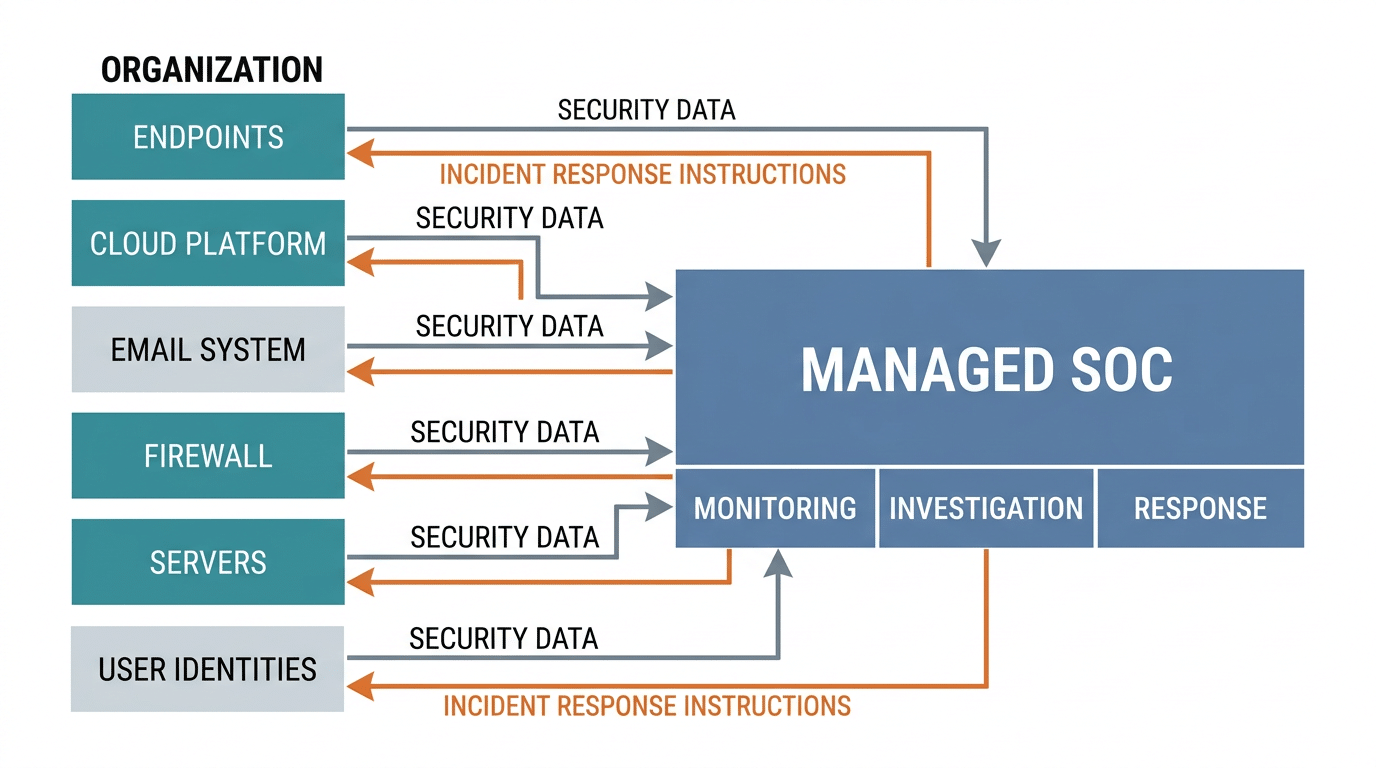




A managed SOC gives organizations access to security monitoring, investigation, and response without requiring them to build a full internal Security Operations Center.
I have seen how quickly alert volumes, cloud systems, remote users, and compliance demands can overwhelm a small IT team.
A managed provider helps by reviewing security data, filtering false positives, investigating suspicious activity, and supporting containment when a threat is confirmed.
The service may be fully outsourced or shared with an internal team. It can also include threat hunting, security reporting, tool management, and after-hours support.
Worth Knowing: A cybersecurity tool can generate thousands of alerts every day, but only a small fraction require action. One of a managed SOC’s biggest jobs is filtering out the noise so security teams can focus on real threats.
What is a Managed SOC?
A managed SOC is an outsourced security operations function. A third-party provider handles some or all of the work normally completed by an internal Security Operations Center.
That work may include:
- Monitoring security alerts
- Reviewing logs
- Investigating suspicious activity
- Managing security tools
- Responding to confirmed incidents
- Preparing security reports
- Supporting compliance requirements
The service does not remove every security responsibility from the customer. The business still owns its systems, risk decisions, access policies, and recovery plans.
The exact split of duties depends on the contract. Some providers only investigate and report threats. Others may isolate devices, block malicious activity, or disable affected accounts with customer approval.
A managed SOC can cover the full security operation or support selected areas where an internal team needs help.
How does a Managed SOC Work?
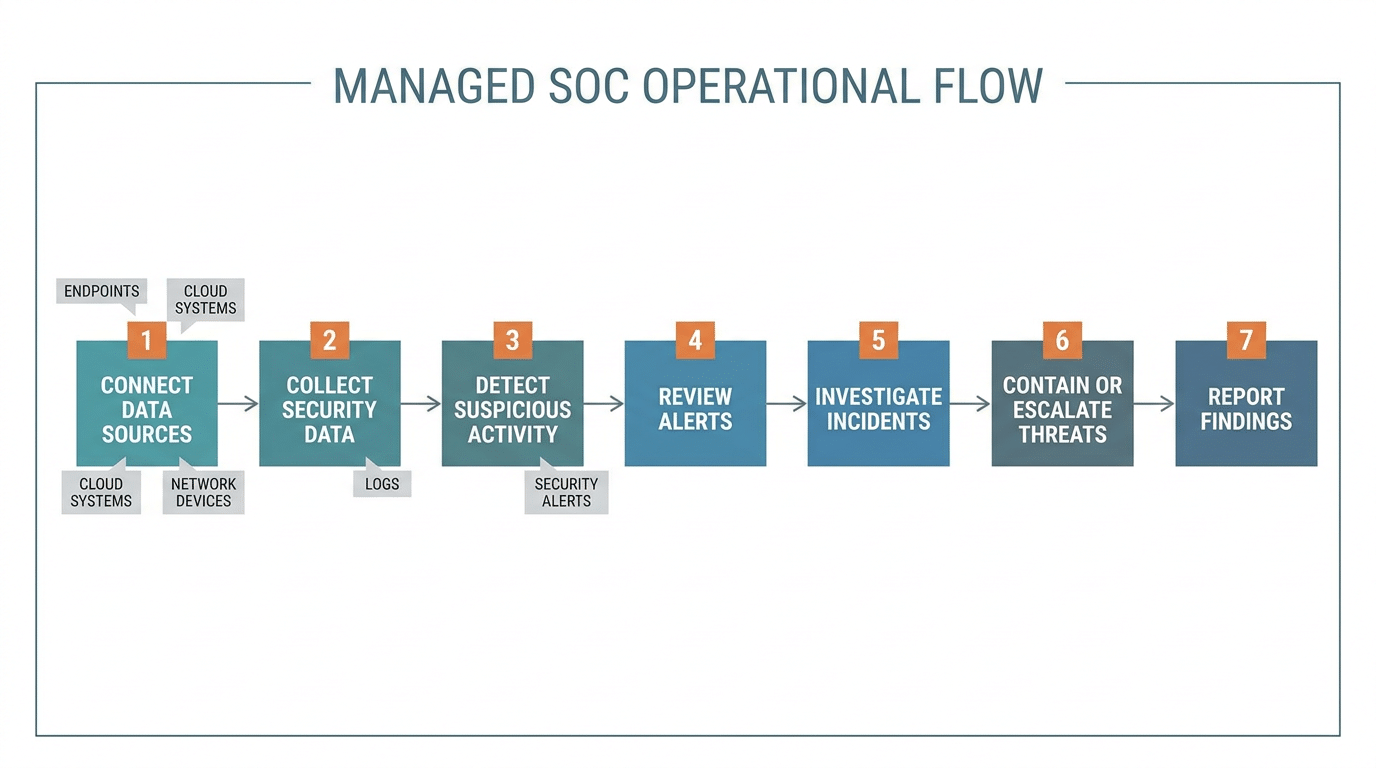
A managed SOC connects to supported systems and security tools to collect the data needed for monitoring and investigation.
The process usually follows these steps:
- Connect Data Sources: The provider connects supported systems, agents, logs, and security tools.
- Collect Security Data: Connected security tools gather logs, alerts, and activity from across the environment.
- Detect Suspicious Behavior: Detection rules and threat data flag unusual events.
- Review the Alert: Analysts check whether the event is harmless, suspicious, or malicious.
- Investigate the Incident: The team studies affected users, devices, files, and activity.
- Contain or Escalate: The provider may isolate a device, stop a process, block access, or contact the customer.
- Report and Improve: Analysts document the incident and adjust security rules where needed.
This process helps reduce false positives while directing attention toward threats that require action.
Managed SOC vs In-House SOC
An in-house SOC is operated by the organization’s own employees. A managed SOC uses an outside provider to complete some or all security operations.
| Factor | Managed SOC | In-House SOC |
|---|---|---|
| Staffing | External analysts | Internal employees |
| Setup time | Usually faster | Often takes longer |
| Control | Shared with provider | Direct internal control |
| Cost model | Subscription or service fee | Salaries, tools, training, and infrastructure |
| Business knowledge | Developed during onboarding | Usually stronger from the start |
| Scaling | Provider adds resources | Requires hiring and new tools |
| Coverage | Often includes continuous monitoring | Depends on team size and shifts |
| Technology | Provider-owned, customer-owned, or mixed | Usually selected internally |
An in-house SOC may suit a large organization with mature security staff and strict control requirements.
A managed SOC may suit a company that needs faster setup, wider coverage, or access to skills it cannot maintain internally.
How does a Managed SOC Compare with Other Security Models?
Terms such as managed SOC, SOC-as-a-Service, MDR, fully managed SOC, and co-managed SOC can overlap. Focus on the provider’s responsibilities, tools, response authority, and contract terms rather than the service name alone.
Managed SOC vs. SOC-as-a-Service
Managed SOC is the broader term for outsourcing part or all of security operations.
SOC-as-a-Service, or SOCaaS, usually refers to a remote subscription service using shared analysts, cloud platforms, standard packages, and monthly or annual pricing.
A managed SOC may also use customer-owned tools, dedicated analysts, on-site support, or a custom responsibility model.
Managed SOC vs. MDR
Managed SOC services usually cover wider security operations, while MDR focuses on detecting, investigating, and responding to threats.
| Factor | Managed SOC | MDR |
|---|---|---|
| Main focus | Broad security operations | Threat detection and response |
| SIEM management | Often included | May not be included |
| Threat hunting | May be included | Usually a core service |
| Compliance support | Often available | Usually limited |
| Response | Coordinates across teams | Focuses on containment and remediation |
Some managed SOC packages include MDR. Compare the deliverables, support hours, containment authority, and response process.
Fully Managed vs. Co-Managed SOC
A fully managed SOC places most monitoring, investigation, reporting, and response coordination with the provider. The customer still controls policies, risk decisions, and major approvals.
A co-managed SOC divides responsibilities between the provider and the internal team. The provider may handle after-hours monitoring, triage, and threat hunting, while internal staff manages business decisions and daytime response.
Fully managed services suit teams with limited security resources. Co-managed services suit established teams that need added coverage or expertise.
What does a Managed SOC Monitor?
A managed SOC monitors security activity across the systems, devices, and services connected to an organization’s environment. Coverage commonly includes:
- Endpoints, laptops, and servers
- Firewalls, routers, and network devices
- Cloud platforms and hosted applications
- Email, identity, and access systems
- Remote access and VPN tools
- Third-party services and security platforms
- Authentication events and unusual login activity
- Security alerts from SIEM, EDR, and other tools
Analysts review logs, alerts, network activity, user behavior, and signs of suspicious access. However, coverage depends on the provider’s supported integrations and the service agreement.
During onboarding, confirm which assets and logs are included, how long data is retained, how alerts are prioritized, and where monitoring gaps may remain.
Core Managed SOC Services
The table below explains the core services a managed SOC provides and what each service covers.
| Service | What It Covers |
|---|---|
| Continuous monitoring | Tracks security activity across connected systems during agreed coverage hours |
| Alert triage | Filters false positives and prioritizes credible alerts |
| Incident investigation | Reviews users’ devices, log files, and network activity |
| Threat response | Isolates endpoints, blocks connections, or supports containment |
| Threat hunting | Searches for suspicious activity that standard alerts may miss |
| Log management | Collects and reviews logs for detection, reporting, and forensics |
| Root cause analysis | Identifies how an incident started and which weakness was involved |
| Security reporting | Summarizes incident response times, risks, and compliance evidence |
Some providers also include security assessments, platform management, detection updates, and recovery support.
Technologies Used in a Managed SOC
A managed SOC uses several connected technologies to collect security data, detect suspicious activity, support investigations, and coordinate response.
- SIEM: Collects and compares logs from different systems to identify related security events.
- EDR: Monitors endpoints for suspicious files, processes, account activity, and system changes.
- XDR: Combines data from endpoints, networks, email, identities, and cloud environments.
- SOAR: Automates routine tasks such as collecting evidence, opening cases, and blocking threats.
- Threat Intelligence: Provides information about known malicious files, domains, tools, and attack methods.
These tools support the service, but effective security also depends on trained analysts, clear procedures, and defined response authority.
Who Needs a Managed SOC?
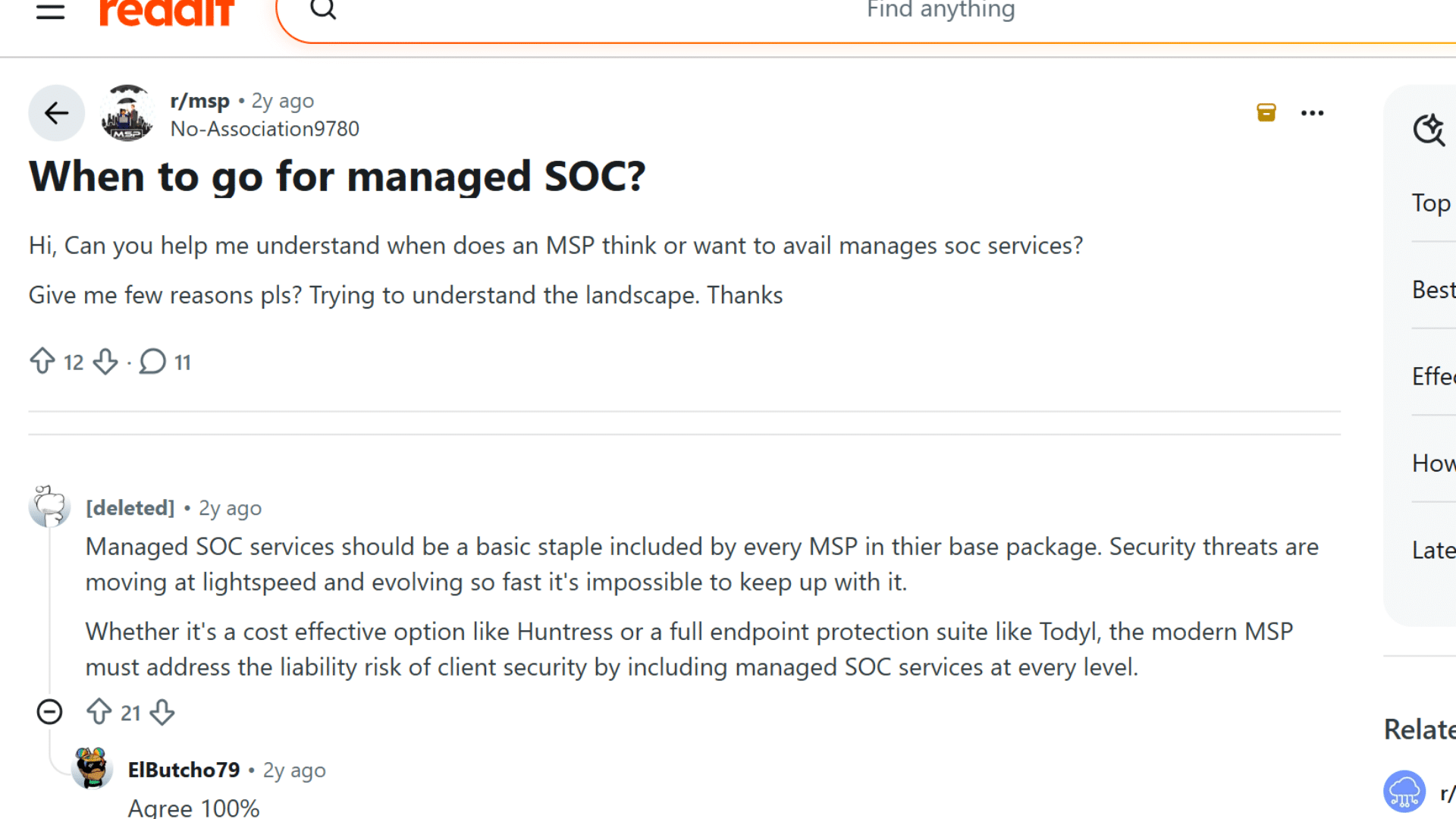
A managed SOC may suit an organization with limited security staff, a growing alert backlog, or security tools that generate data without anyone available to review it.
In this Reddit discussion, several MSP professionals highlighted several reasons for using managed monitoring:
- Endpoint, email security, and SIEM tools provide limited value when alerts are not reviewed.
- Continuous log monitoring can improve threat detection and response speed.
- Providers may support root-cause analysis, remediation guidance, and compliance reporting.
- Managed services can provide coverage when internal employees are unavailable.
- Building an internal SOC may be too expensive for smaller organizations.
- Managed coverage may become easier to offer across 50 to 100 endpoints.
- Solo IT professionals and small teams cannot manually watch every suspicious event.
- MSPs should clearly document any security risks that remain the client’s responsibility.
I recommend listing the security tasks the internal team cannot complete reliably, then comparing those gaps with the provider’s monitoring hours, response duties, pricing, and actual service scope.
Benefits and Challenges of a Managed SOC
A managed SOC can improve security coverage, but each benefit may come with a related trade-off.
| Factor | Benefit | Challenge |
|---|---|---|
| Staffing | Provides access to analysts, threat hunters, incident responders, and cloud security specialists. | External analysts may need time to understand critical systems and business processes. |
| Monitoring | Extends monitoring beyond the internal team’s available hours. | Coverage may be limited by unsupported systems, missing logs, or service hours. |
| Alert Management | Filters false positives and sends credible threats to the internal team. | Poorly configured tools may still generate unnecessary or incomplete alerts. |
| Scalability | Adds coverage as the business gains users, devices, locations, or cloud accounts. | Costs may rise as endpoint numbers, log volume, and data retention increase. |
| Control | Reduces the daily workload placed on internal security and IT teams. | The customer may have less direct control over analysts, tools, and detection rules. |
| Response | Can support containment by isolating devices, stopping processes, or blocking accounts. | Response authority may be limited or require customer approval before action. |
| Data Handling | Centralized logs support investigations, reporting, and compliance reviews. | The provider may access or store sensitive security and user activity data. |
| Reporting | Gives technical teams, executives, and auditors regular security information. | Reports may lack useful context when service expectations are not clearly defined. |
| Provider Relationship | Gives the organization access to established security processes and expertise. | Changing providers may be difficult when logs, rules, and records are stored in provider-owned systems. |
My Advice: Review coverage, response rights, data handling, pricing, and exit terms before selecting a managed SOC provider.
Final Thoughts
A managed SOC is most valuable when it fills clear gaps in staffing, monitoring, investigation, or response. It can close gaps in coverage, investigation, technology management, and incident response
However, the service also requires careful review of data access, response authority, integrations, pricing, and provider dependence. You should compare responsibilities before signing any agreement.
Confirm which systems are monitored, how alerts are handled, who can contain threats, where logs are stored, and what happens when the contract ends.
Managed SOC, SOC-as-a-Service, and MDR may overlap, but their deliverables can differ.
The right choice should support the organization’s actual risks, internal skills, compliance needs, and long-term security operations plan without adding unnecessary complexity.
Frequently Asked Questions
Is a Managed SOC the Same as SOC-as-a-Service?
The terms are often used interchangeably. Managed SOC is the broader outsourced operating model, while SOC-as-a-Service usually refers to a remotely delivered subscription service.
Can a Managed SOC Replace an Internal Security Team?
It can replace many daily SOC tasks, but the organization still needs someone to own risk decisions, policies, recovery priorities, and provider management.
Does a Managed SOC Respond to Attacks?
Some providers can contain threats directly, while others only investigate and recommend actions. Response authority should be stated clearly in the contract.
How Much does a Managed SOC Cost?
Pricing may depend on endpoint count, user count, log volume, data retention, service hours, tools, response scope, and compliance reporting.
How Long does Managed SOC Onboarding Take?
Onboarding time depends on the number of systems, integrations, data sources, and access requirements. A simple setup may take weeks, while complex environments can take longer.