




I have been covering tech for years, and I have seen many “next big things” come and go. Most of them fade away. But optical computing feels different. It keeps coming up in real research, and it is hard to ignore why.
I had the same thought, so I spent time learning what it really means and how it could shape the future of technology.
It is part of a wider wave of computing innovations that are changing how systems process and move data.
Unlike regular computers that use electricity, this approach uses light to process data, which can make things much faster and more efficient. This shift could change how quickly we handle data in daily life.
In this article, I’ll explain how optical computing works in simple terms. I’ll also cover its main benefits, where it’s used today, and the challenges that remain.
By the end, you’ll have a clear understanding of why this technology matters and how it may impact the devices you use every day.
What Is Optical Computing?
Optical computing is a type of computing that uses light (photons) instead of electricity (electrons) to process and store data.
In simple terms, it replaces traditional electronic signals with light signals to perform calculations. This allows data to move much faster and with less energy loss.
Instead of using wires and circuits in the usual way, optical systems rely on lasers, lenses, and fiber optics to handle information.
Because light can travel very quickly and carry more data at once, optical computing has the potential to improve speed and efficiency in modern technology. This field brings together photonics and computer science.
One key area is photonic integrated circuits (PICs), which use light instead of electricity.
Big companies like Intel and IBM, along with startups like Lightmatter and Luminous Computing, are investing a lot to bring this tech to market.
It is still growing, but it may shape future computers, data centers, and communication systems.
How Optical Computing Works?
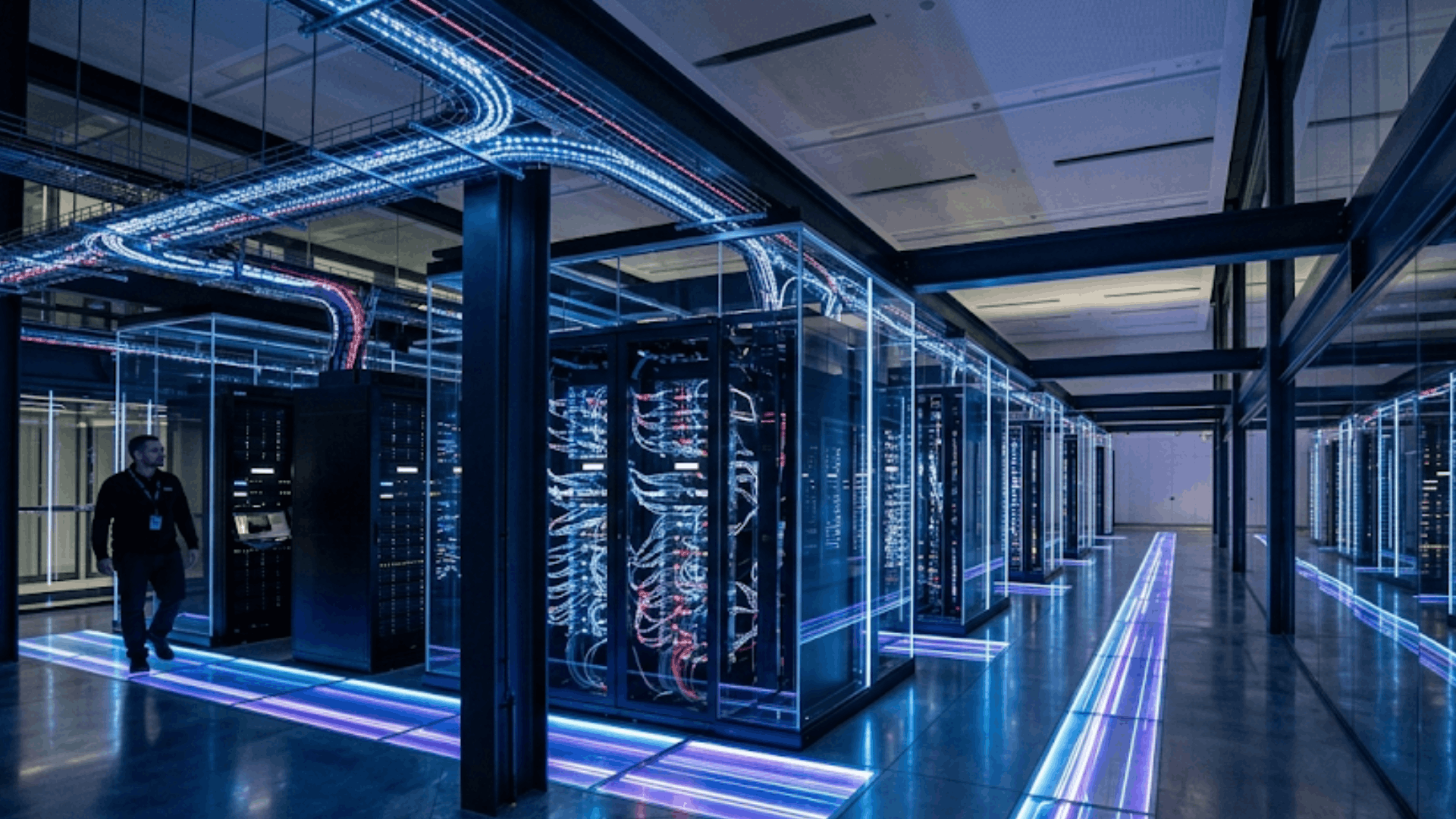
Optical computing uses light signals to carry and process data rather than electrical currents. These light signals move through optical components to perform calculations at very high speeds.
- Light Source: Lasers create focused beams of light that carry information. These beams serve as the primary input for data processing.
- Modulators: Modulators change the light signals to represent data like 0s and 1s. This step allows information to be encoded into light waves.
- Waveguides/Fiber Optics: These guide the light through different parts of the system. They help keep the signal strong and on the correct path.
- Optical Logic Gates: These parts process data by controlling how light beams interact. They perform operations similar to electronic circuits but at higher speeds.
- Detectors: Detectors receive the light signals at the end of the process. They convert the light back into electronic data for output or storage.
Optical Interconnects vs. Full Optical Processing
It is worth distinguishing between two things that often get grouped together. Optical interconnects use light only to transfer data between chips or servers; the actual computation still happens electronically.
Full optical processing, which is further along in research than in commercial products, performs the computation itself in the optical domain.
Most commercial deployments today use optical interconnects.
Full optical logic is still largely at the prototype stage, which is an important context when evaluating vendor claims.
Optical vs Electronic Computing: Key Differences
Optical computing uses light to process data, while electronic computing uses electrical signals. These differences affect speed, energy use, and overall performance.
| Feature | Optical Computing | Electronic Computing |
|---|---|---|
| Data Carrier | Light (photons) | Electricity (electrons) |
| Speed | Very high (near the speed of light) | Slower compared to light-based systems |
| Energy Efficiency | Lower heat and power loss | Higher energy consumption |
| Heat Generation | Minimal | Produces more heat |
| Data Capacity | Can handle large amounts of data at once | Limited by electrical bandwidth |
| Technology Maturity | Still developing | Well-established and widely used |
| Signal Interference | Less interference | More prone to signal noise |
| Scalability | Easier for high-speed data growth | Limited by physical circuit constraints |
Why Optical Computing Is Faster and More Efficient?
Optical computing offers faster data processing and greater energy efficiency than traditional systems. It helps modern technology handle large amounts of data with less heat and power use.
- High Speed: Light travels extremely fast, allowing quicker data processing. This can improve performance in tasks like AI and big data.
- Energy Efficiency: Optical systems use less power and produce less heat. This helps reduce energy costs and cooling needs.
- Large Data Handling: Optical computing can process large amounts of data simultaneously. This is useful for cloud computing and data centers.
- Low Heat Output: Less heat means systems can run longer without overheating. It also improves hardware lifespan.
- Better Bandwidth: Light can carry more data than electrical signals. This allows faster communication and data transfer.
- Improved Performance: Overall system speed and efficiency increase. This leads to smoother and faster technology use.
Impact of Optical Computing on Data Center Sustainability
Optical computing can play a major role in improving data center sustainability by reducing energy use and heat generation.
Traditional data centers rely on electronic systems that consume large amounts of power and require heavy cooling. In contrast, optical systems use light, which produces less heat and allows data to move more efficiently.
This can cut cooling needs and lower energy costs. I’ve seen cooling become the highest cost in large facilities.
The physics of optical interconnects, no I²R losses, no electromagnetic interference between channels, addresses that problem directly rather than just managing it.
That’s what makes the sustainability case for optics genuinely compelling, not just marketing language.
With optical computing, faster data processing also means tasks are completed quickly, saving more energy.
As this technology develops, it could help create greener data centers with lower carbon impact and better long-term performance
Different Applications of Optical Computing
Optical computing is already being tested in real-world systems where speed and energy use matter the most. Many industries use it to improve performance, reduce energy consumption, and handle large volumes of data.
1. Artificial Intelligence and Neural Networks
Researchers at places like UCLA are building optical neural networks that can process images almost instantly using light.
These systems do not need heavy electrical power, which makes them faster and more efficient. They are being used to improve self-driving cars, robotics, and medical imaging tools.
By handling complex tasks with light, they reduce the load on regular processors and help machines make quick, accurate decisions in real time.
Tip: Ideal for AI systems that need fast, real-time image or data processing.
2. Edge Computing and Low-Power Devices
Cornell researchers are studying how optical systems can work in small, energy-limited devices. These systems are useful for edge computing, where data is processed close to its source.
To understand how this differs from centralized approaches, it helps to look at cloud computing vs edge computing and how each handles data differently.
This includes remote sensors, smart devices, and field equipment.
Optical computing can handle specific tasks with less power than traditional chips. This makes it a strong choice for areas where battery life and efficiency are important.
Tip: Best for devices with limited power and that need efficient local processing.
3. 5G and Communication Networks
Studies led by Princeton show that optical processing can improve signal quality in 5G networks and radar systems. It helps reduce errors and improve signal clarity, resulting in faster, more reliable connections.
This is important for modern communication systems that must handle large amounts of data traffic.
Optical computing supports better network performance and helps build a stronger, more secure communication infrastructure.
Tip: Ideal for improving network speed and reducing signal issues in communication systems.
4. Hybrid Computing Systems
Many companies in the U.S. are working on hybrid systems that combine optical and electronic computing.
In these setups, optical parts handle high-speed calculations, such as data processing, while electronic parts handle logic and control.
This approach helps avoid delays caused by switching between systems.
It also improves overall speed and efficiency. Hybrid models are seen as a practical step toward full optical computing in the future.
Tip: A smart choice for systems that need both speed and flexible control.
5. Commercial and Industry Use
Optical computing is slowly entering commercial use, especially in data centers and high-performance systems. Companies are testing it to handle large workloads with less energy and faster speeds.
It can help reduce power and cooling costs in large server systems.
While still developing, it shows strong potential for use in cloud services, finance, and advanced computing environments where performance is critical.
Tip: Ideal for businesses managing large amounts of data and looking to cut energy costs.
Why Optical Computing Is Faster than Traditional Systems?
Optical computing is faster than traditional systems because it uses light instead of electricity to move and process data.
Light travels much faster than electrical signals, allowing information to pass through the system at very high speeds.
It also faces less resistance, so data can move smoothly without much delay or energy loss. Another reason is that optical systems can handle multiple data streams at the same time, increasing overall efficiency.
In contrast, electronic systems often slow down due to heat and signal limits.
Optical computing reduces these issues, making it better suited for tasks that require fast processing, such as AI, data centers, and large-scale computing systems.
This makes it a strong option for future technologies that demand high-performance, reliability, and scalability.
Optical Computing: Strengths and Limitations
Optical computing offers major gains in speed and energy efficiency, but it also poses technical and cost challenges. Understanding both sides helps you see where it stands today.
| Aspect | Strengths | Limitations |
|---|---|---|
| Speed | Extremely fast data processing using light | Complex design to maintain high-speed accuracy |
| Energy Use | Low power consumption and less heat | Expensive setup and specialized components |
| Data Handling | Handles large data streams at once | Difficult to integrate with current systems |
| Signal Quality | Less signal loss and interference | Sensitive to alignment and environmental factors |
| Technology Stage | Strong future potential | Still under development and not widely adopted |
| Scalability | Supports high data growth and bandwidth | Scaling hardware is still challenging |
| Cost | Can reduce long-term energy expenses | High initial investment and research costs |
Future Scope of Optical Computing Technology
Optical computing is expected to grow as the need for faster and more efficient technology increases. It has the potential to reshape how data is processed across many industries.
- Advanced AI Systems: Optical computing can boost AI performance by handling large amounts of data quickly. This may lead to smarter and faster decision-making systems.
- High-Speed Data Centers: Data centers could become more efficient, producing less heat and using less energy. This helps reduce costs and improve performance.
- Better Communication Networks: It can support faster internet and stronger network signals. This is useful for 5G and future communication systems.
- Hybrid Computing Growth: Optical and electronic systems can work together to achieve balanced performance. This approach can solve current limitations.
- Miniaturization of Technology: Researchers are working to make optical components smaller and more practical. This can help bring the technology into everyday devices.
- Wider Industry Adoption: Fields such as healthcare, finance, and robotics may increasingly adopt optical computing. This can improve speed, accuracy, and efficiency in real-world tasks.
Is Optical Computing the Next Big Breakthrough?
Yes, optical computing has the potential to become a major breakthrough in future technology.
As the demand for faster processing and lower energy use grows, optical computing stands out as a strong solution. It can handle large amounts of data at high speed while reducing heat and power consumption.
Many researchers and companies are already investing in this technology to improve AI systems, data centers, and communication networks.
However, it is still in the development stage and faces challenges like high costs and integration issues. Despite this, steady progress is being made to overcome these limits.
If these challenges are solved, optical computing could play a key role in shaping faster, more efficient, and smarter technology in the years ahead.
Common Mistakes to Avoid in Optical Computing
Many people misunderstand optical computing because it is still a new and developing technology. Knowing common mistakes can help you learn them more clearly and avoid confusion.
- Thinking It Replaces All Electronics: Many assume optical computing will fully replace electronic systems. In reality, both will likely work together in hybrid systems.
- Ignoring Current Limitations: Some people believe it is already widely used. However, it is still in the research and early development stage.
- Overestimating Speed in All Cases: While it is very fast, not every task benefits equally from optical computing. Some processes still rely on electronic systems.
- Not Understanding Basic Concepts: Skipping the basics can lead to confusion. It’s important to learn how light-based processing actually works.
- Assuming It Is Cost-Effective Now: Optical systems can be expensive to build and maintain. Large-scale use is still limited due to cost.
- Overlooking Integration Challenges: Combining optical and electronic systems is not simple. It requires careful design and advanced technology.
Conclusion
As I looked deeper into optical computing, I realized it is not just a future idea but something that is slowly shaping how technology will grow.
You might also notice how important speed and energy efficiency have become in today’s digital world.
I have seen how even small improvements in processing can make a big difference, and this technology has the potential to take that much further.
It still has challenges, but progress looks strong. If you stay informed now, you will better understand where tech is heading.
I would love to hear your thoughts. Have you come across optical computing before, or do you see it becoming part of everyday devices? Share your experience or opinion in the comments below.
Frequently Asked Questions
Can Optical Computing Be Used in Personal Computers?
Right now, it is mostly used in research and large systems, not standard home computers.
Is Optical Computing Safer than Electronic Computing?
It can be safer in some cases because it reduces overheating and electrical risks.
Does Optical Computing Require Special Materials?
Yes, it uses materials such as photonic crystals, lasers, and optical fibers to operate.
Can Optical Computing Improve Internet Speed?
Yes, it can help increase data transfer speeds and reduce network delays.
Will Optical Computing Reduce Energy Bills?
In large systems like data centers, it can lower energy use and reduce costs.