





A few years ago, most conversations about AI felt experimental. Today, they feel unavoidable.
Even when I’m reading industry news, evaluating new software, or watching how businesses operate, AI and automation seem woven into almost every discussion about the future.
That’s one reason topics like Droven.io Future Technology USA are attracting so much attention. What makes the conversation interesting is that it goes beyond a single tool or trend.
Businesses are increasingly moving away from standalone applications and toward connected digital ecosystems that combine AI, cloud computing, cybersecurity, automation, and data-driven decision-making.
The growing interest around Droven.io Future Technology USA isn’t really about one tool or platform.
It’s about how multiple technologies are beginning to work together to reshape the way businesses operate.
What Exactly is Droven.io Future Technology?
At its core, Droven.io’s future technology describes a connected technology ecosystem, the idea that AI, cloud computing, automation, and security work as one system rather than separate tools.
The focus sits on digital transformation: helping businesses understand how these pieces fit together before spending money on them.
The angle is practical productivity, not hype.
When I first sorted through it, that framing clicked. It is less a product to buy and more a lens for seeing how modern technology actually connects.
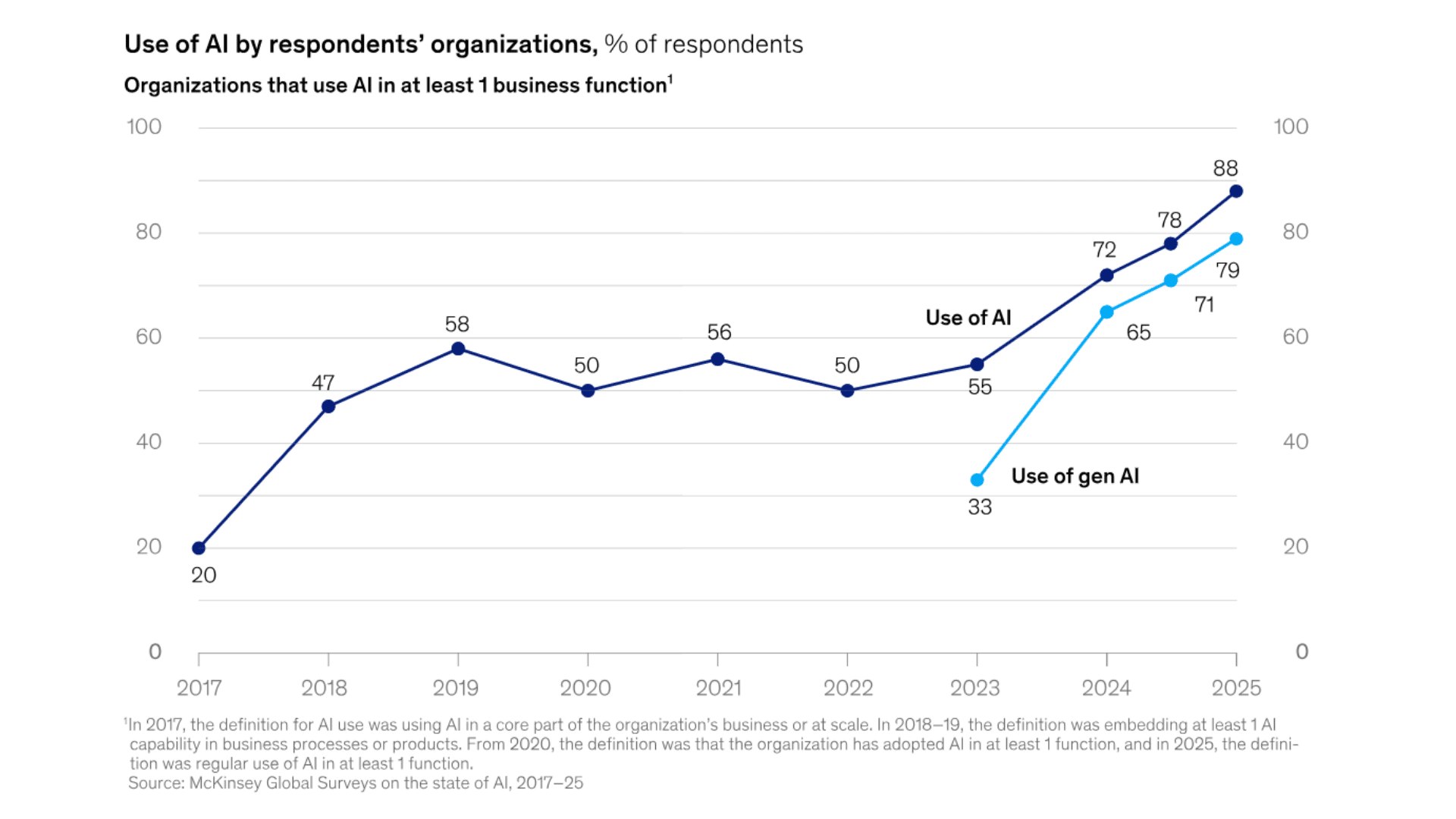
This connected view matches where the market actually is. McKinsey’s 2025 survey found that 88 percent of organizations now use AI in at least one business function, up ten percentage points from the year before, which is why a joined-up approach is no longer optional.
What Droven.io Appears to be, and What it is Not
Here is where honesty matters, and where this guide deliberately parts ways with most of what ranks for this keyword.
Several of the top results describe Droven.io as a “powerful digital innovation platform” that “connects AI and smart data systems.”
I could find no public evidence for that. There is no pricing page, no login, no product demo, no documentation.
Based on what is visible, it reads less like a software vendor and more like an educational hub that explains technology in plain language.
There is no clear pricing page, login, or product demo to point to.
The table below summarizes what can currently be inferred from publicly available information and where uncertainty around positioning still exists.
| Question | Current Understanding |
|---|---|
| Software company? | Limited public evidence |
| SaaS automation tool? | Unclear |
| Educational technology hub? | More likely |
| AI platform? | Not directly |
Public information around Droven.io remains limited, so separating confirmed information from assumptions is important. This guide flags what is known versus what is inferred, so the picture stays honest.
Why Droven.io Future Technology Matters Right Now
A connected view of technology is no longer optional, and the reason comes down to scale.
The money involved is now too large to ignore, and the businesses treating these systems as one ecosystem are the ones pulling ahead.
Adoption is racing to keep pace with the opportunity, with enterprise AI use climbing sharply over the past year and workplace tools spreading quickly.
The takeaway is steady: the hard part is no longer finding tools; it is understanding how they connect and which ones fit.
Key Data Points
- An estimated $15.7 trillion potential AI contribution to the global economy by 2030, a 14% GDP boost split into $6.6 trillion from productivity gains and $9.1 trillion from consumption effects (PwC).
- $2.6 trillion to $4.4 trillion in possible annual value from generative AI across industries (McKinsey).
- Droven IO Future Technology USA is a topic/keyword, not a purchasable product.
- The real payload is understanding how AI, cloud, automation, cybersecurity, robotics, and semiconductors connect across US industries.
- AI is the central driver; cloud and edge are the backbone; cybersecurity and governance are the constraint.
- The competitive edge for businesses now comes from integration and adaptability, not from buying more isolated tools.
How Droven.io Future Technology Creates a Connected Digital Ecosystem
Modern technology rarely works as isolated systems anymore.
AI models, automation workflows, cloud infrastructure, and cybersecurity layers increasingly operate as interconnected components that continuously exchange data and improve performance.
Understanding these connected layers helps explain why modern digital systems are becoming more adaptive, scalable, and efficient across industries.
The following sections break down the core components of this ecosystem and explain how each layer contributes to smarter technology operations.
1. The Connected Ecosystem at a Glance

Understanding how modern technology systems interact becomes easier when viewed as a connected ecosystem rather than separate tools working independently.
The table below breaks down the core layers of a connected technology ecosystem, showing how each component contributes to data flow, automation, security, and continuous business improvement.
| Step | Technology Layer | Purpose |
|---|---|---|
| 1 | Data Sources | Collect data from systems, users, applications, and workflows |
| 2 | AI Models | Analyze information, identify patterns, and generate insights |
| 3 | Automation Engines | Execute tasks and automate repetitive processes |
| 4 | Cloud Infrastructure | Store, process, and connect systems at scale |
| 5 | Security Layer | Protect data, manage risks, and maintain compliance |
| 6 | Business Decisions | Turn insights into actions and strategic decisions |
| 7 | Continuous Optimization | Improve systems continuously using feedback and results |
2. Artificial Intelligence Layer
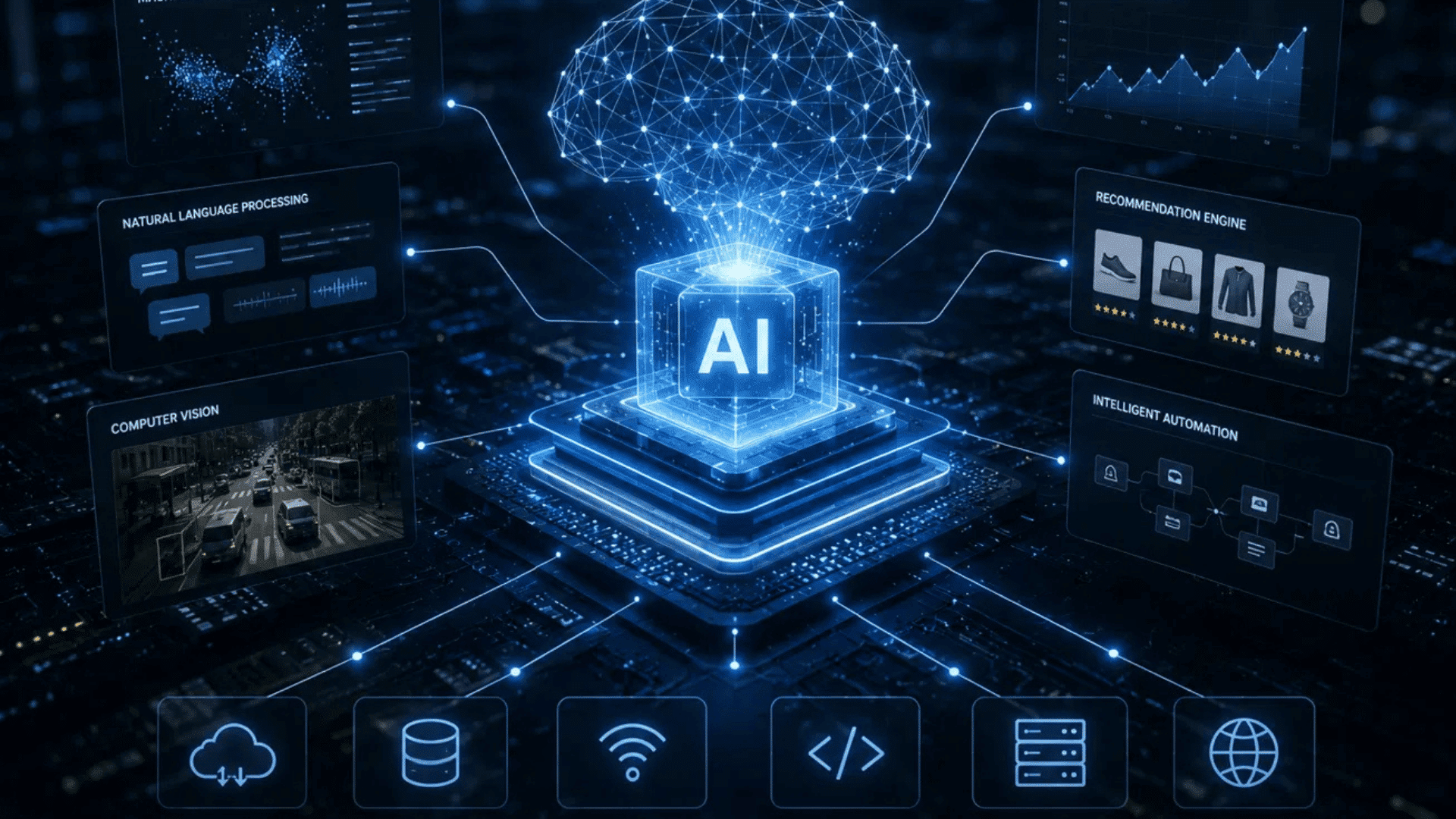
Artificial intelligence acts as the intelligence engine within connected technology ecosystems.
Businesses increasingly use predictive AI, machine learning systems, AI agents, and business intelligence tools to automate complex workflows.
In the US specifically, NIST’s AI Risk Management Framework has become the reference point for how organizations are expected to deploy these systems responsibly, emphasizing trustworthiness, accountability, and the management of AI risk across the full lifecycle.
The table below highlights the key components of the AI layer and their contributions to connected technology ecosystems.
| AI Component | Primary Role |
|---|---|
| Predictive AI | Forecast outcomes and identify patterns from historical data |
| Machine Learning Models | Learn from data and improve performance over time |
| AI Agents | Perform tasks autonomously and manage multi-step workflows |
| Business Intelligence | Convert raw data into actionable insights |
| Continuous Learning | Refine outputs and improve accuracy through feedback loops |
3. Automation Layer
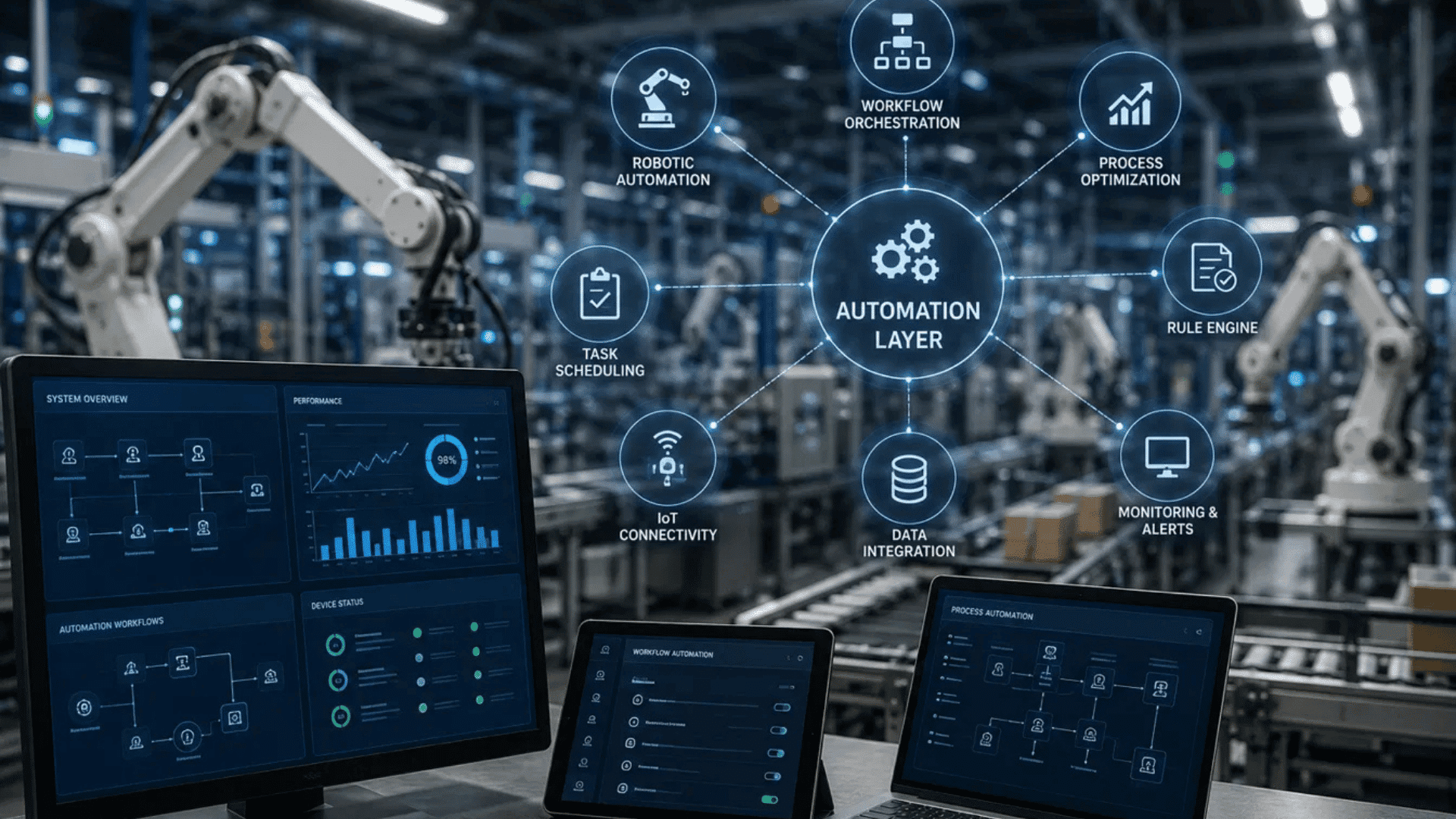
Automation transforms intelligence into action.
Once AI identifies patterns or opportunities, automation engines execute repetitive processes with minimal human involvement.
Modern workflow automation now handles customer service routing, document processing, reporting tasks, marketing campaigns, and operational workflows simultaneously.
AI orchestration expands automation by linking multiple tools, systems, and workflows into a unified process.
Instead of relying on fixed instructions, these connected workflows dynamically adjust based on inputs, conditions, and real-time data, helping organizations improve speed, reduce bottlenecks, and streamline operations.
Here’s the demonstration of the Automation Workflow
Input Data → Task Analysis → AI Decision → Workflow Execution → Performance Tracking
4. Cloud Infrastructure Layer

Cloud infrastructure provides the foundation that keeps connected technology systems scalable and accessible.
Instead of operating on isolated servers, businesses increasingly rely on distributed cloud environments to process data, run applications, and support remote collaboration.
This infrastructure also allows AI models, automation tools, and analytics platforms to exchange information in real time across interconnected environments.
The newer wrinkle is edge computing: rather than shipping every byte back to a central cloud, US industries running smart factories, fleet logistics, and healthcare monitoring now process data near where it is created to cut latency.
Edge and IoT are increasingly part of what readers expect under “future technology,” not an afterthought.
5. Cybersecurity and Governance Layer

As technology ecosystems become more connected, security becomes more complex.
Cybersecurity layers protect sensitive information, maintain compliance standards, and reduce operational risks across integrated systems.
Organizations must address AI-specific risks, including data privacy concerns, model vulnerabilities, unauthorized access, and governance challenges.
Strong cybersecurity frameworks combine monitoring systems, compliance policies, access controls, and automated threat detection to create safer digital environments while supporting large-scale automation and cloud adoption.
In practice, US organizations increasingly anchor this around zero-trust architectures, identity and access management, and supply-chain security, the same priorities NIST and CISA have pushed as connected systems widen the attack surface.
6. Semiconductor Layer, The Foundation Everything else Runs on

Every layer above depends on advanced chips.
AI training and inference, cloud data centers, robotics, and connected devices all need increasingly powerful silicon, which is why semiconductors have become a strategic resource rather than a back-office component.
In the US, this is also a national-policy story: federal investment in domestic chip manufacturing and research is explicitly aimed at securing the supply chain that future technology depends on.
Without reliable chip capacity, most of the trends in this guide simply can’t scale.
7. The US Policy Layer, Why “USA” Is in the Keyword

Future technology in America isn’t shaped only by private companies.
Federal investment in semiconductor manufacturing, AI research, cybersecurity programs, and advanced manufacturing is actively steering the ecosystem’s direction, and public-private collaboration is expected to continue accelerating it while balancing economic competitiveness and national security.
For readers, the practical takeaway is that US tech direction is partly a policy bet, not just a market one.
Real-World Industries Already Using Similar Connected Systems
Connected technology ecosystems look different across industries, but the underlying goal remains the same: to combine data, automation, and intelligence to solve operational challenges faster and more efficiently.
The table below highlights how different sectors apply connected systems, the benefits they gain, and the technologies powering these transformations.
| Industry | How Connected Systems Are Used | Real-World Impact | Common AI Tools / Platforms |
|---|---|---|---|
| Healthcare | Automates scheduling, patient records, documentation, and care coordination workflows | Reduces clinician paperwork and improves patient flow through AI-assisted documentation | Microsoft Cloud for Healthcare, Nuance DAX, Epic Systems |
| Ecommerce | Uses personalization engines, demand forecasting, and inventory prediction systems | Improves customer experiences and helps businesses optimize stock management and delivery speed | Amazon Web Services, Shopify AI, Salesforce Commerce Cloud |
| Finance | Detects unusual transaction patterns and automates compliance and reporting workflows | Improves fraud prevention, speeds risk analysis, and reduces manual monitoring | Visa AI Solutions, Mastercard Cyber Solutions, IBM Watson |
| Logistics | Optimizes delivery routes, predicts disruptions, and automates operational decisions | Reduces delays, lowers fuel costs, and improves supply chain efficiency | UPS ORION, SAP Supply Chain, Oracle Logistics Cloud |
Real-Life Case Study: How AI-Driven Workflows Improve Productivity
Most writing on connected technology stays abstract, so when I went looking for a documented, real deployment I could point to rather than a hypothetical, the clearest one came from enterprise sales, where employees must quickly retrieve information, respond to customer questions, and manage large amounts of internal knowledge during live interactions.
Case Study: AI-Powered Enterprise Sales Workflows at Microsoft
Researchers documented how Microsoft deployed a production AI assistant in enterprise seller workflows to reduce information-retrieval friction and improve workflow efficiency.
Instead of forcing employees to search across multiple systems, the assistant integrated directly into existing workflows and surfaced relevant information during customer interactions.
The deployment focused on reducing context switching, improving access to internal knowledge, and supporting faster decision-making during live conversations.
What Changed in Practice?
| Challenge | AI-Driven Solution | Productivity Impact |
|---|---|---|
| Information is scattered across systems | Integrated AI retrieval system | Faster access to relevant information |
| Employees switching between tools | Workflow-integrated assistant | Reduced workflow interruptions |
| Slow search processes | Real-time content retrieval | Quicker customer responses |
| Knowledge fragmentation | Unified information access | Better operational efficiency |
Key Takeaways
- Real-time content retrieval improved access to relevant information during live interactions
- Workflow integration reduced friction caused by switching between systems
- Embedded AI support improved speed without forcing teams to change workflows completely
- Production deployment showed measurable benefits beyond experimental environments
Source:
How Microsoft is reinventing sales with Microsoft Copilot PDF
Tools and Platforms Shaping the Modern Developer Ecosystem
Modern software development is no longer centered around writing code alone. Developers increasingly work inside connected ecosystems where AI tools, automation pipelines, cloud infrastructure, and deployment platforms operate together.
These technologies reduce repetitive work, accelerate releases, and help teams build software faster, but they also raise expectations around technical breadth and adaptability.
| Tool Category | What It Does | Common Examples | Why Developers Use It |
|---|---|---|---|
| AI Coding Assistants | Support code generation, debugging, and documentation | GitHub Copilot, ChatGPT, Claude | Speeds up coding and reduces repetitive tasks |
| CI/CD Pipelines | Automate testing, integration, and deployment workflows | GitHub Actions, Jenkins, GitLab CI/CD | Shortens release cycles and improves reliability |
| Container Systems | Package applications consistently across environments | Docker, Kubernetes | Improves portability and scalability |
| Cloud Deployment Platforms | Host, manage, and scale applications | AWS, Google Cloud, Azure | Enables faster deployment and infrastructure flexibility |
Challenges and Risks in Future Technology

As AI systems, cloud platforms, and automation tools become more deeply integrated into business operations, organizations face challenges that extend beyond technology itself.
The question is no longer whether companies should adopt these systems, but whether they can manage the risks that come with faster digital transformation.
Key Risks Emerging in 2026
The rapid expansion of connected systems creates opportunities, but it also exposes businesses and workers to new vulnerabilities that require stronger governance, better planning, and continuous adaptation.
- Job Displacement from Automation: Repetitive, process-driven tasks are increasingly automated, disrupting the workforce and shifting skill requirements.
- AI Misinformation and Deepfakes: Generative AI enables large-scale creation of synthetic content, heightening trust issues, misinformation risks, and verification challenges.
- Cybersecurity Complexity Increase: Expanding digital ecosystems create larger attack surfaces, making security management more difficult and expensive.
- Cloud Dependency Risks: Growing reliance on external cloud providers increases exposure to outages, vendor lock-in, service disruptions, and infrastructure concentration risks.
- Increased System Interdependency Risks: As businesses connect more applications, APIs, and automation layers, failures in one component can trigger cascading disruptions across multiple systems and workflows.
- Workforce Skill Gap Expansion: Rapid technology adoption often outpaces employee training, creating capability gaps that slow transformation efforts and increase pressure for continuous upskilling
Future Outlook of Droven.io Future Technology
Several emerging shifts are shaping how connected technology ecosystems evolve.
These trends show where businesses, developers, freelancers, and organizations may focus as digital systems become increasingly integrated and automated.
AI Embedded in Software Ecosystems
AI is rapidly shifting from optional functionality to embedded infrastructure. Industry forecasts suggest enterprise software is moving toward built-in AI assistants and specialized agents rather than standalone AI products.
Most enterprise applications are expected to include embedded AI capabilities as organizations move toward agent-driven workflows.
Autonomous Cybersecurity Systems
Security environments are becoming too complex for fully manual operations. Organizations increasingly experiment with AI-driven monitoring, threat detection, and response automation.
Cybersecurity is among the earliest adopters of agentic AI systems because threat environments require rapid decision-making.
Research increasingly points toward multi-agent and semi-autonomous security workflows rather than isolated monitoring systems.
Invisible Cloud Infrastructure
Cloud infrastructure is increasingly becoming abstracted away from end users.
Businesses focus less on server management and more on outcomes. Infrastructure platforms increasingly automate scaling, workload distribution, and resource optimization.
Serverless and cloud-native architectures continue shifting operational complexity away from developers and businesses.
AI-Assisted Freelancing Economy
Freelancers increasingly use AI for research, coding, content generation, and operational workflows.
Research analyzing millions of freelancer interactions shows growing demand for AI-related work and increasing integration of generative AI tools across independent work ecosystems.
AI increasingly acts as an augmentation layer rather than purely replacing freelance work.
Startup Focuses on Integration Rather Than Invention
Many future startups may create less value by building entirely new technologies and more by connecting existing systems more effectively.
Businesses increasingly need platforms that reduce fragmentation by integrating AI tools, cloud systems, automation workflows, and data infrastructure.
Companies that simplify interoperability, reduce workflow friction, and improve cross-platform communication may create stronger long-term competitive advantages.
Bringing it all Together
After exploring Droven IO Future Technology USA, I found that the keyword represents something broader than a single platform or product.
It shows a growing shift toward connected technology ecosystems where AI, automation, cloud infrastructure, cybersecurity, and intelligent workflows operate together rather than separately.
From healthcare and finance to software development and freelancing, the pattern remains consistent: organizations increasingly create value through integration, automation, and continuous optimization rather than isolated tools.
What stood out most to me across the research is how little the term describes a thing you can buy, and how much it describes a way of seeing future technology adoption now looks less like purchasing software and more like learning how systems interact.
If this guide helped simplify the topic, keep exploring emerging trends, test new workflows, and follow how technologies connect because understanding ecosystems increasingly matters more than understanding individual tools.
Frequently Asked Questions
Is Droven.io Free to Use?
Droven.io appears to be a free informational platform rather than a subscription-based service.
Who is the Droven IO Future Technology USA Topic For?
It primarily serves tech professionals, career changers, entrepreneurs, and business leaders tracking AI and automation trends.
Is Droven IO Specific to the United States?
Yes, it focuses on US technology developments, including AI investment, startup growth, policy, infrastructure, and careers.