



If you are wondering what AI detectors colleges use, Turnitin is one of the most visible academic systems, but no single detector is used by every college. Policies can differ by university, department, and even professor.
Temple University, for example, gives trained faculty access to Turnitin’s AI detector, while Arcadia University renewed Turnitin AI Writing Detection for the 2026 – 27 academic year.
Washington State University took the opposite approach and canceled its Turnitin AI-detection contract in February 2026.
Professors may also encounter standalone tools such as GPTZero or Copyleaks, but detector scores are not universal proof of AI use.
Continue reading to obtain the list of more AI detectors relevant to college writing.
What AI Detectors Do Colleges Use?
If you are trying to understand which AI detectors colleges use, there is no single tool you should expect to see everywhere.
Turnitin AI Writing Detection is one of the most relevant because many colleges already use Turnitin, but access depends on institutional licensing and policy.
Some universities enable it, while others, such as Penn State, have not purchased the AI-detection add-on.
A 2026 Digital Education Council survey also found that 19% of faculty using AI in teaching used it to detect academic dishonesty.
Below, I’ve ranked 10 detectors by college relevance to help you understand. Have a look!
1. Turnitin AI
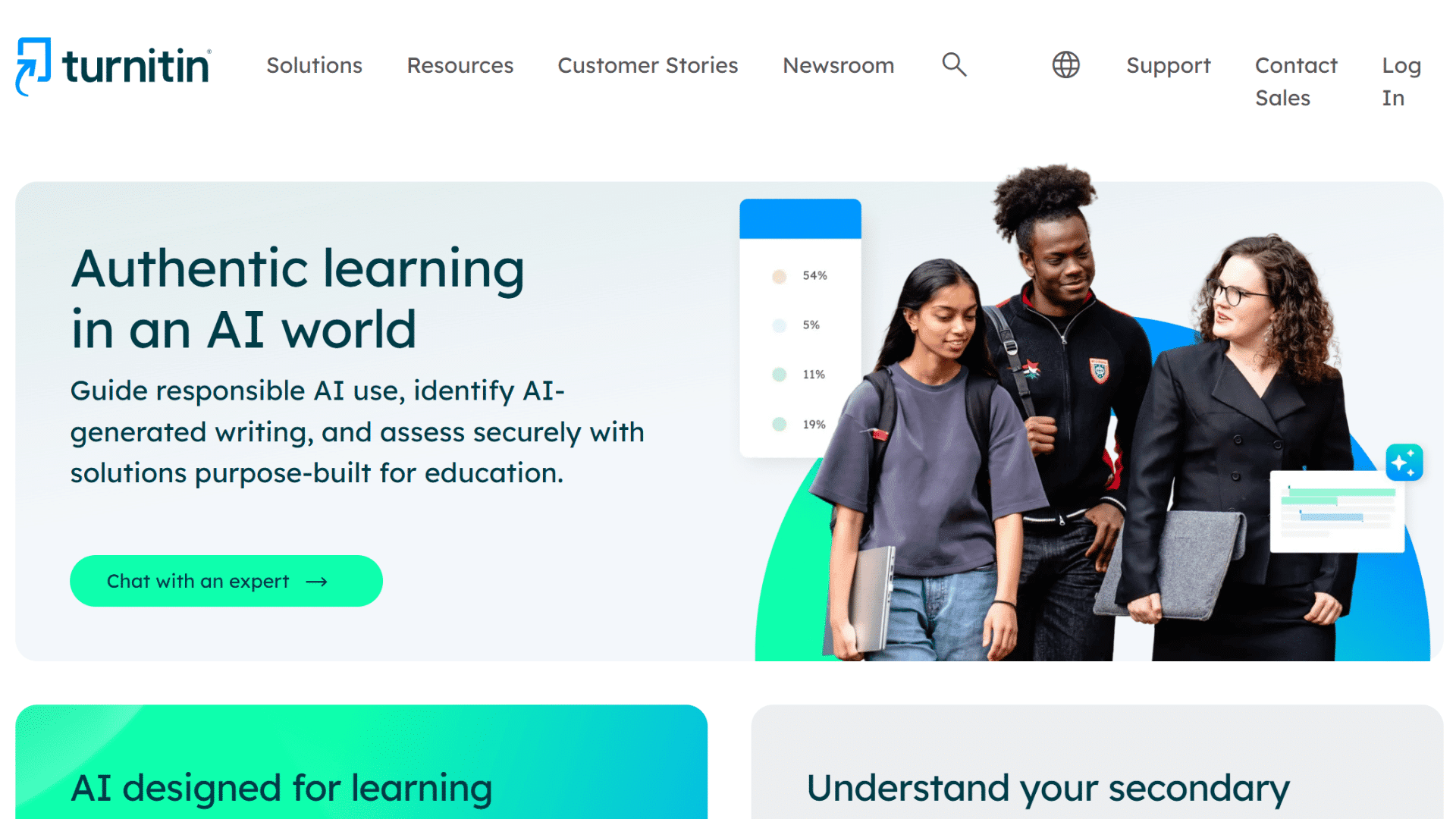
Turnitin ranks first because students are most likely to encounter it in an established academic-integrity workflow.
- College relevance: 10/10 based on institutional adoption, academic focus, and integration with existing submission systems.
- Its AI Writing Report appears alongside Turnitin’s other assessment tools when a university enables the feature.
- Scores from 1% to 19% appear as
*%reflecting greater uncertainty at lower detection levels rather than a cheating threshold.
2. Copyleaks
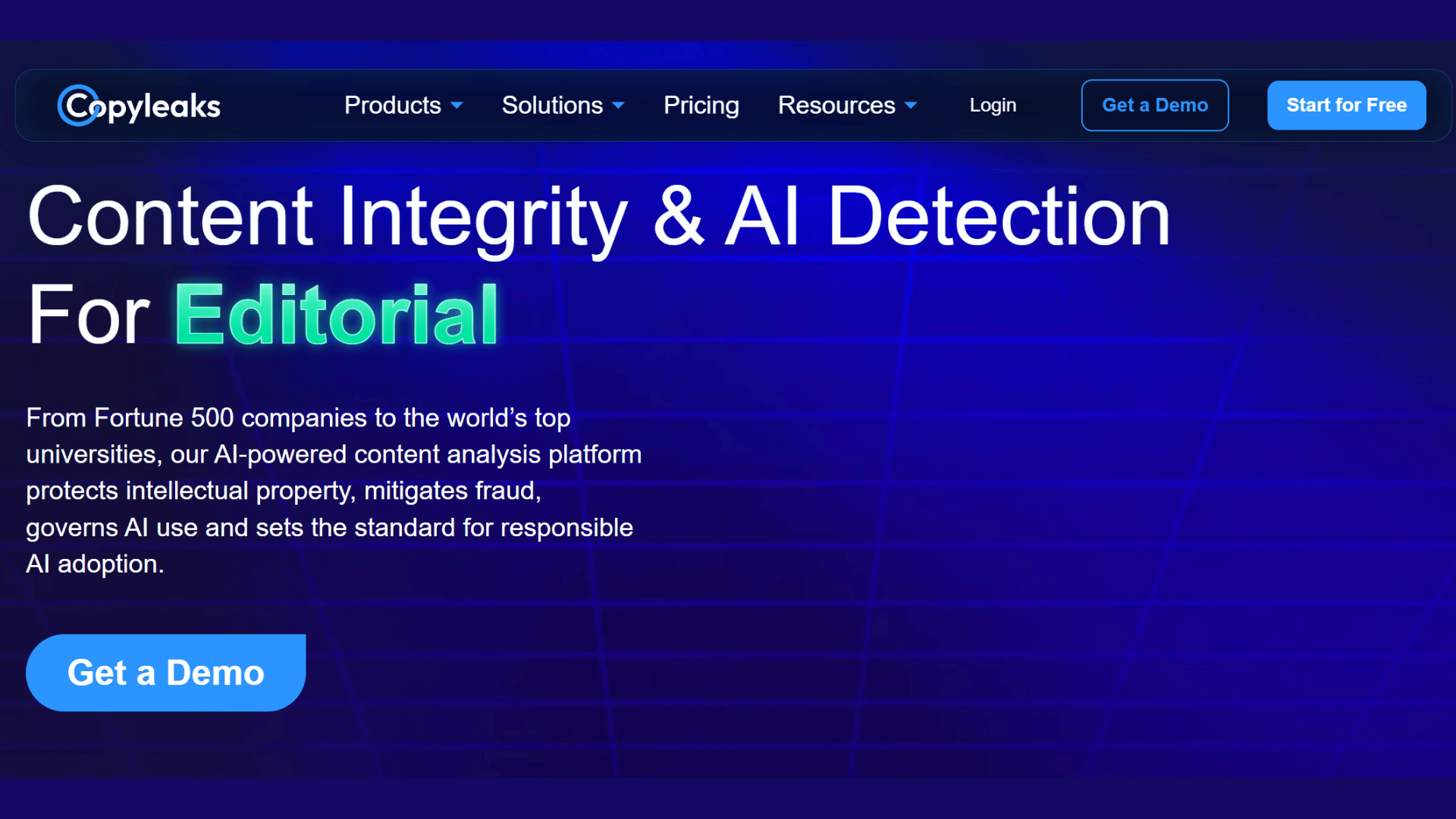
Copyleaks ranks highly because it is designed to work inside the learning platforms colleges already use.
- College relevance: 9/10 for its institutional focus and broad LMS support.
- It integrates with Canvas, Moodle, Brightspace, and Blackboard, allowing instructors to review results within course systems.
- Its newer AI Logic feature can give instructors explanations and examples behind flagged content rather than showing only an AI score, and it is available through major LMS platforms.
3. GPTZero
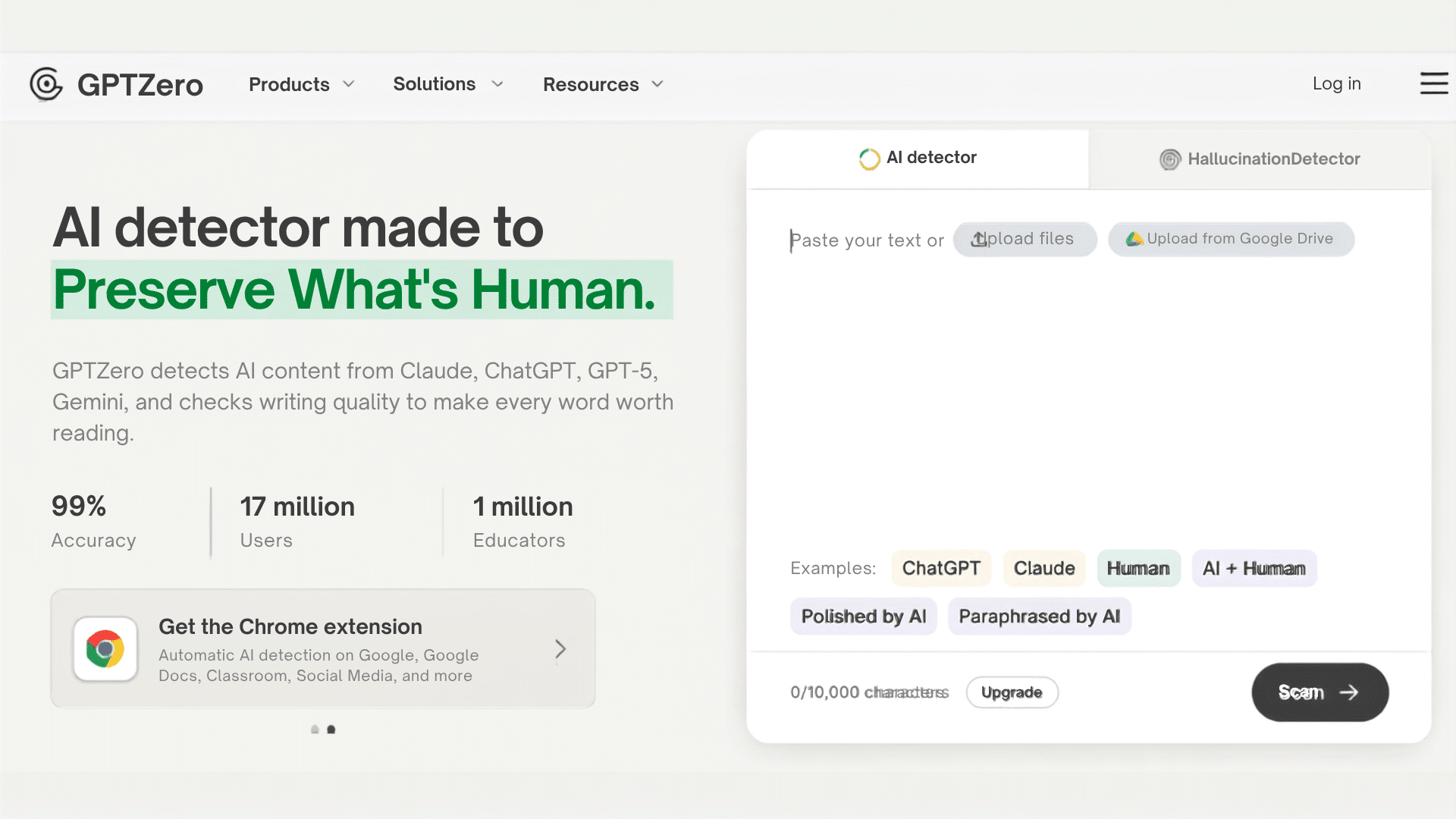
GPTZero is more accessible to individual professors and students than a traditional university-wide submission system.
- College relevance: 8.5/10 because of its education focus, classroom tools, and presence in independent research.
- It provides document-level scores and highlights passages considered likely to contain AI-generated writing.
- GPTZero can analyze writing at the document, sentence, and word level, highlighting the specific parts it considers more likely to be AI-generated.
4. Pangram
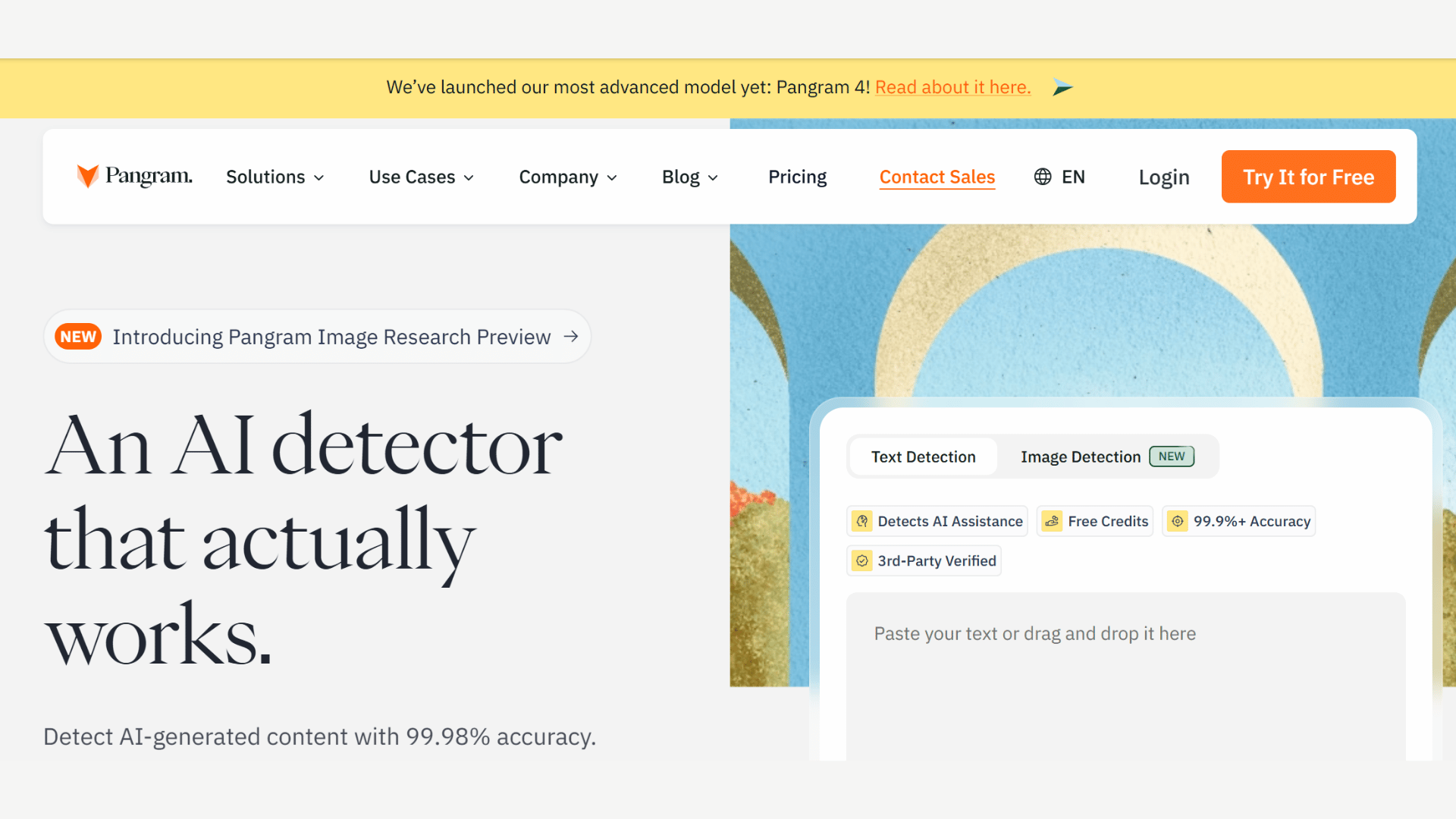
Pangram is a newer option, but its university focus and recent research make it increasingly relevant.
- College relevance: 8.5/10 based on higher-education positioning, LMS integrations, and independent testing.
- In Canvas, Pangram can run detection in the background and surface results inside SpeedGrader, while its Moodle integration can analyze submissions from the gradebook.
- A 2026 study in the International Journal for Educational Integrity compared Pangram with Turnitin, Copyleaks, and GPTZero, providing stronger independent support for this ranking.
5. Originality.ai Academic
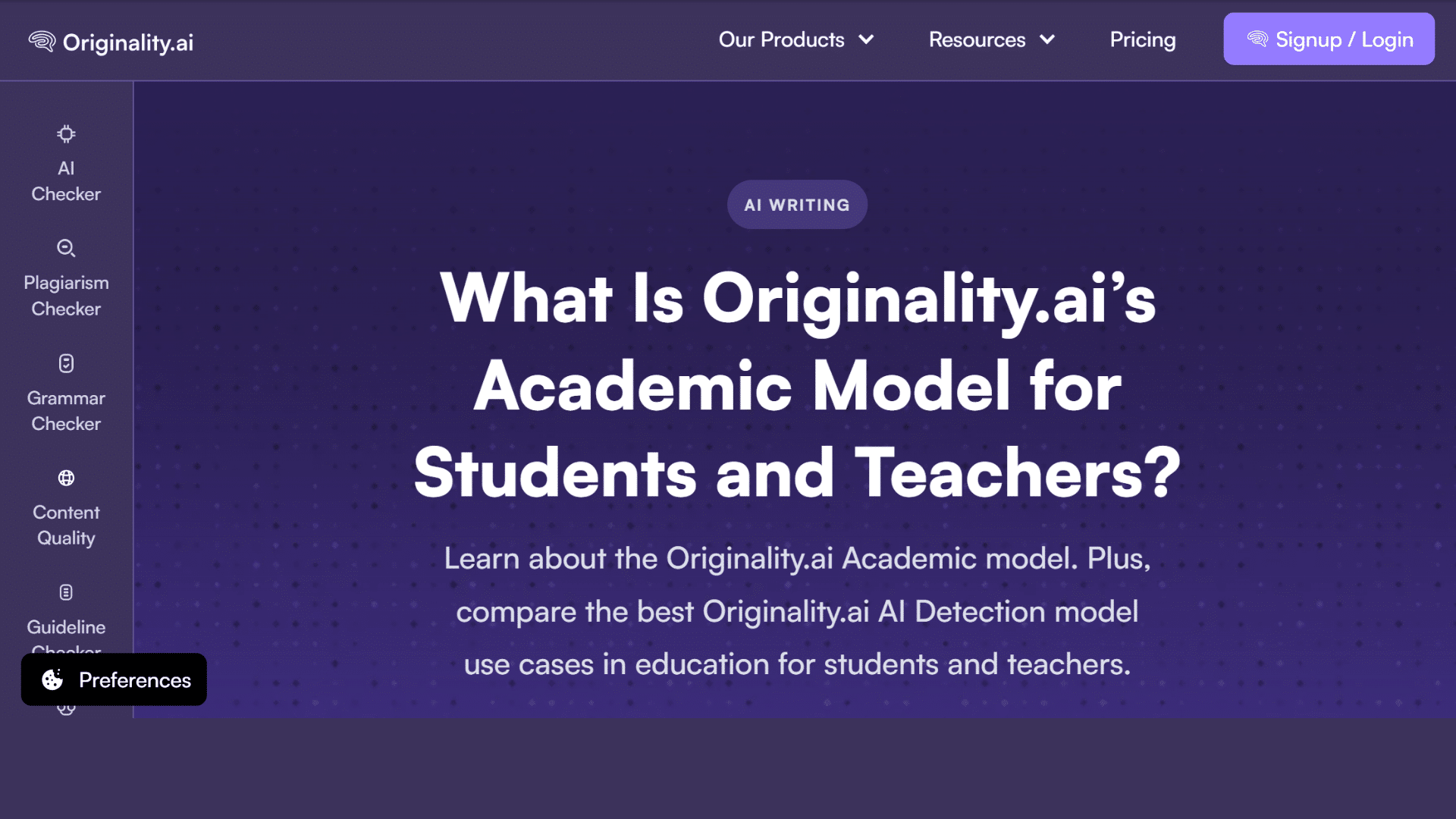
Originality.ai is more useful for specific academic contexts than as evidence of widespread university adoption.
- College relevance: 7/10 because it offers education-focused detection but has less visible institutional presence than the top tools.
- Its Academic model is designed particularly for STEM-related assignments and technical writing.
- Much of its published accuracy information comes from the company itself, so treat those figures as vendor claims rather than independent proof of performance.
6. Grammarly AI Detector
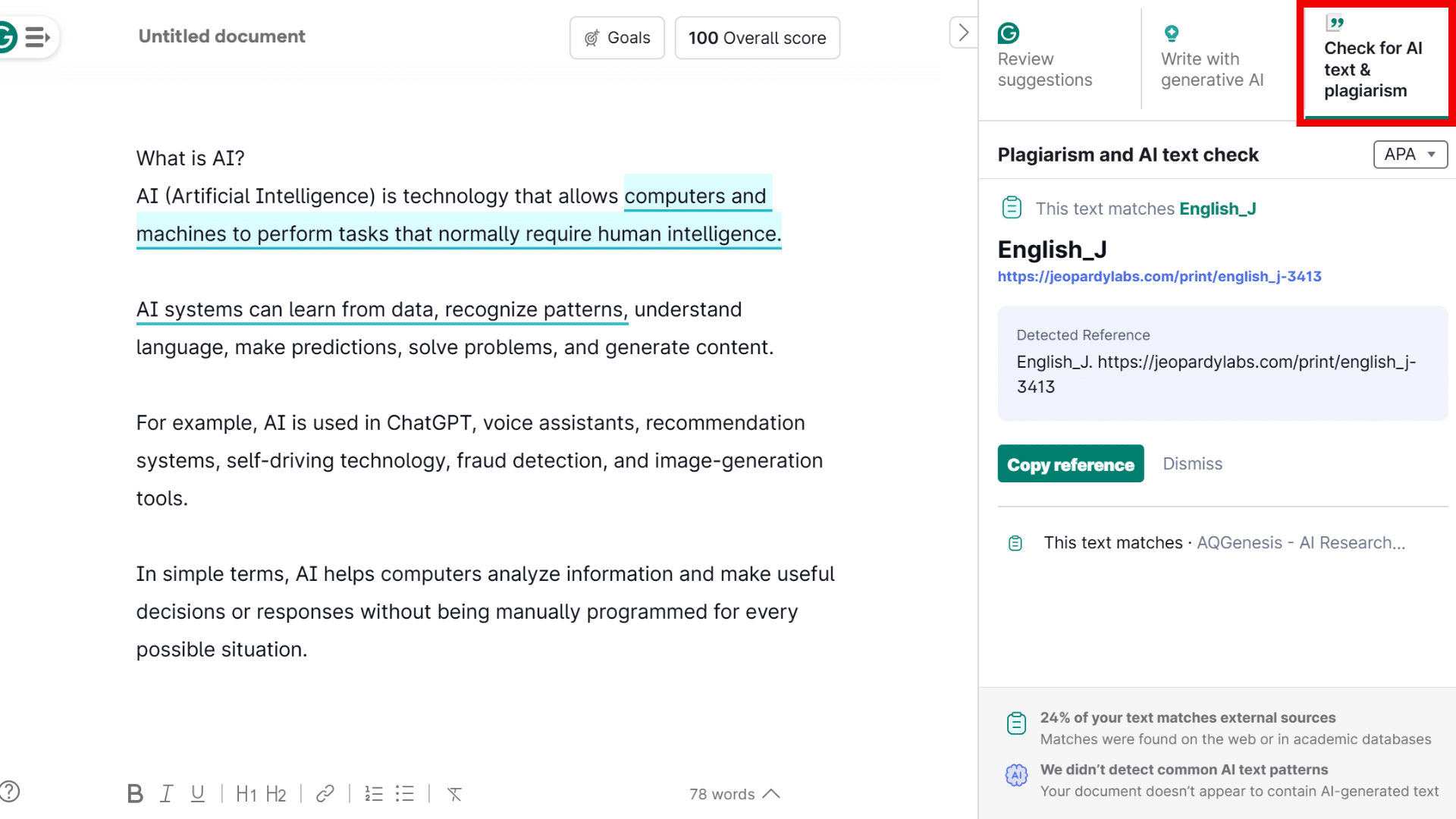
Grammarly differs from most tools here because it can provide evidence about the writing process, not just a detection percentage.
- College relevance: 7/10 due to its education products and growing institutional use.
- Authorship can record whether text was typed, pasted, copied, or created with AI assistance.
- For students, that process history may provide useful context when a detector raises concerns, especially when genuine drafting work needs to be demonstrated.
7. Scribbr AI Detector
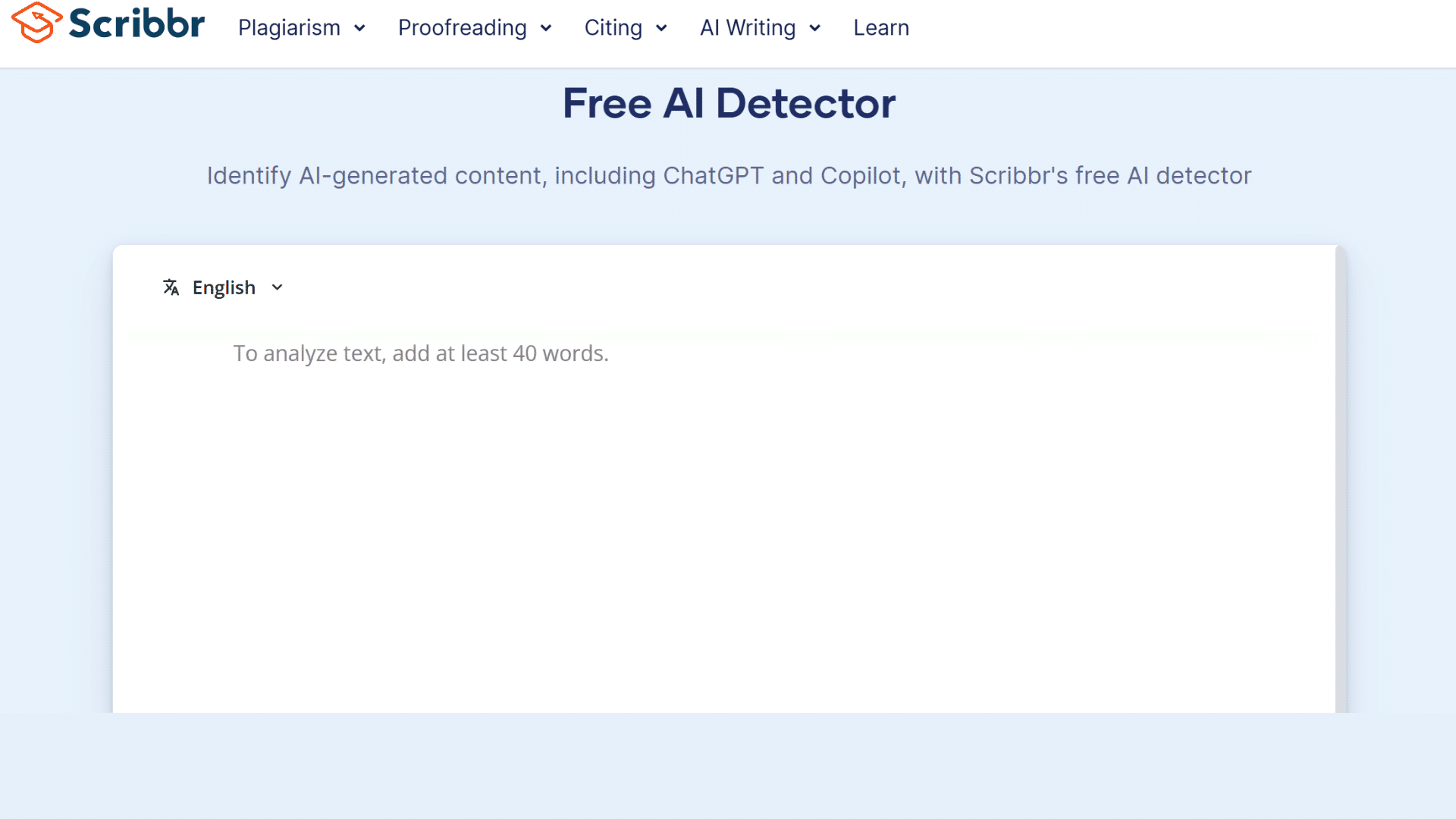
Scribbr is more relevant as a student self-checking tool than as a detector commonly embedded in college systems.
- College relevance: 6/10 because of its strong academic-writing focus but limited evidence of institutional deployment.
- Students can check essays before submission and see how another detector interprets their writing.
- A Scribbr result should not be treated as a prediction of Turnitin or another campus tool because different detectors use different models and scoring methods.
8. QuillBot AI Detector
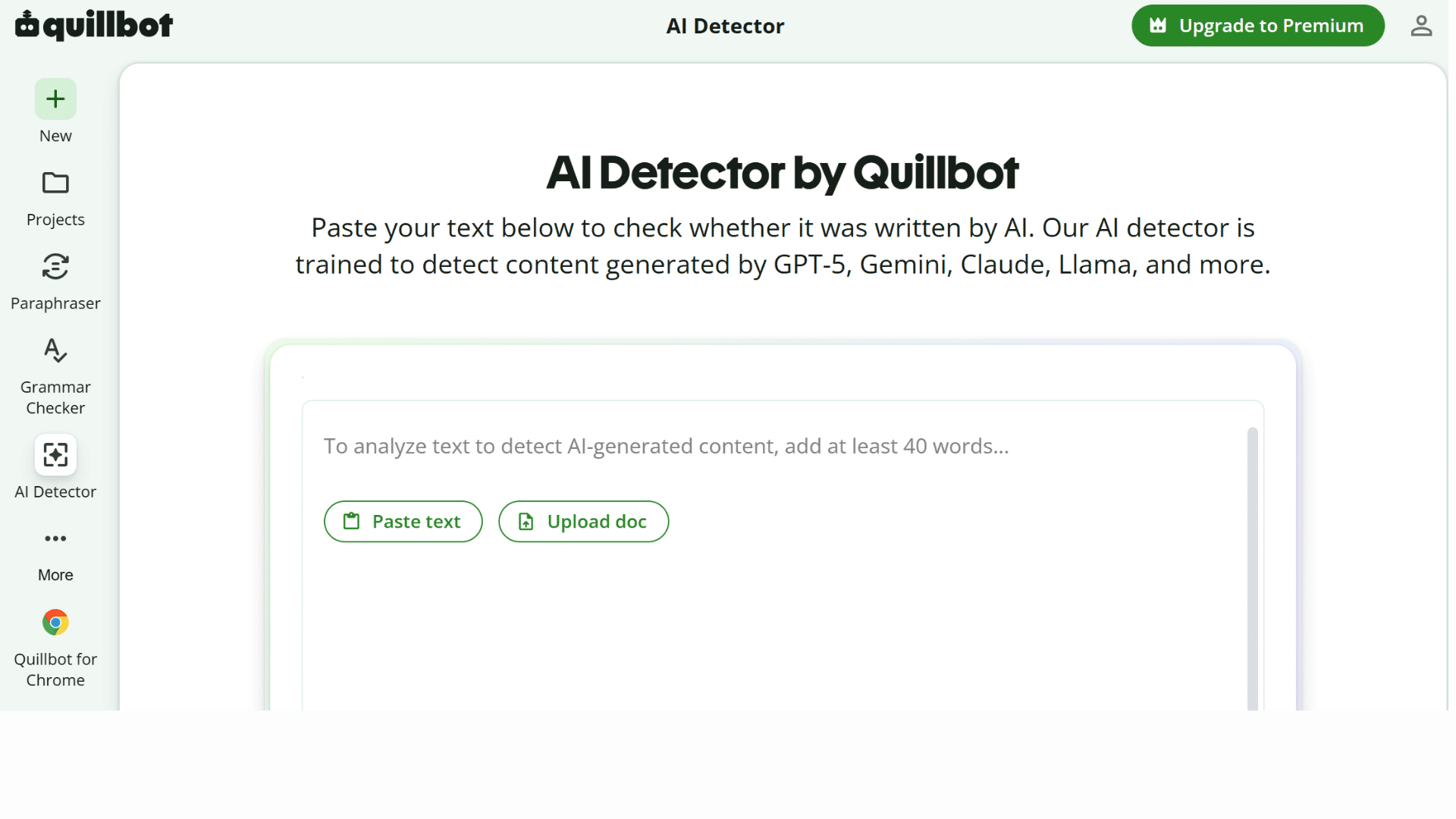
QuillBot is useful primarily when students want an accessible second opinion on academic writing.
- College relevance: 5.5/10 because student accessibility is stronger than evidence of university-wide adoption.
- Its detector provides an overall result with sentence-level analysis, making flagged passages easier to review.
- If genuine work is flagged, students should check drafts, sources, and revision history rather than rewriting sentences simply to reduce an AI score.
9. Winston AI
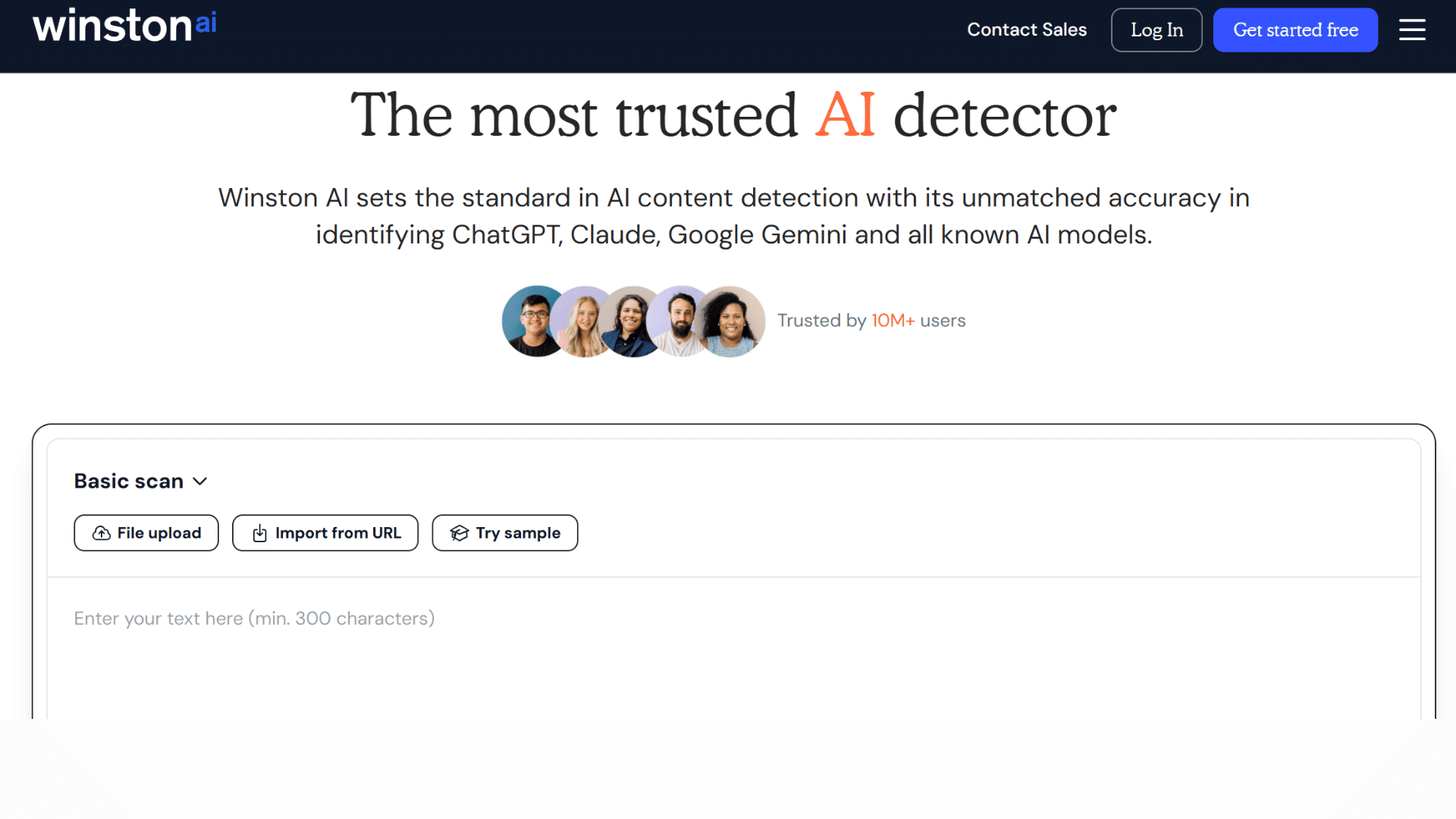
Winston AI has a clear education use case but is better viewed as a standalone detector than a major university submission platform.
- College relevance: 5/10 based on its educator tools and academic-integrity positioning.
- It offers sentence-level analysis and shareable reports that can support instructor review outside an LMS.
- Its lower ranking reflects the limited evidence of broad college deployment, so students should not assume a Winston result matches what their institution would see elsewhere.
10. ZeroGPT
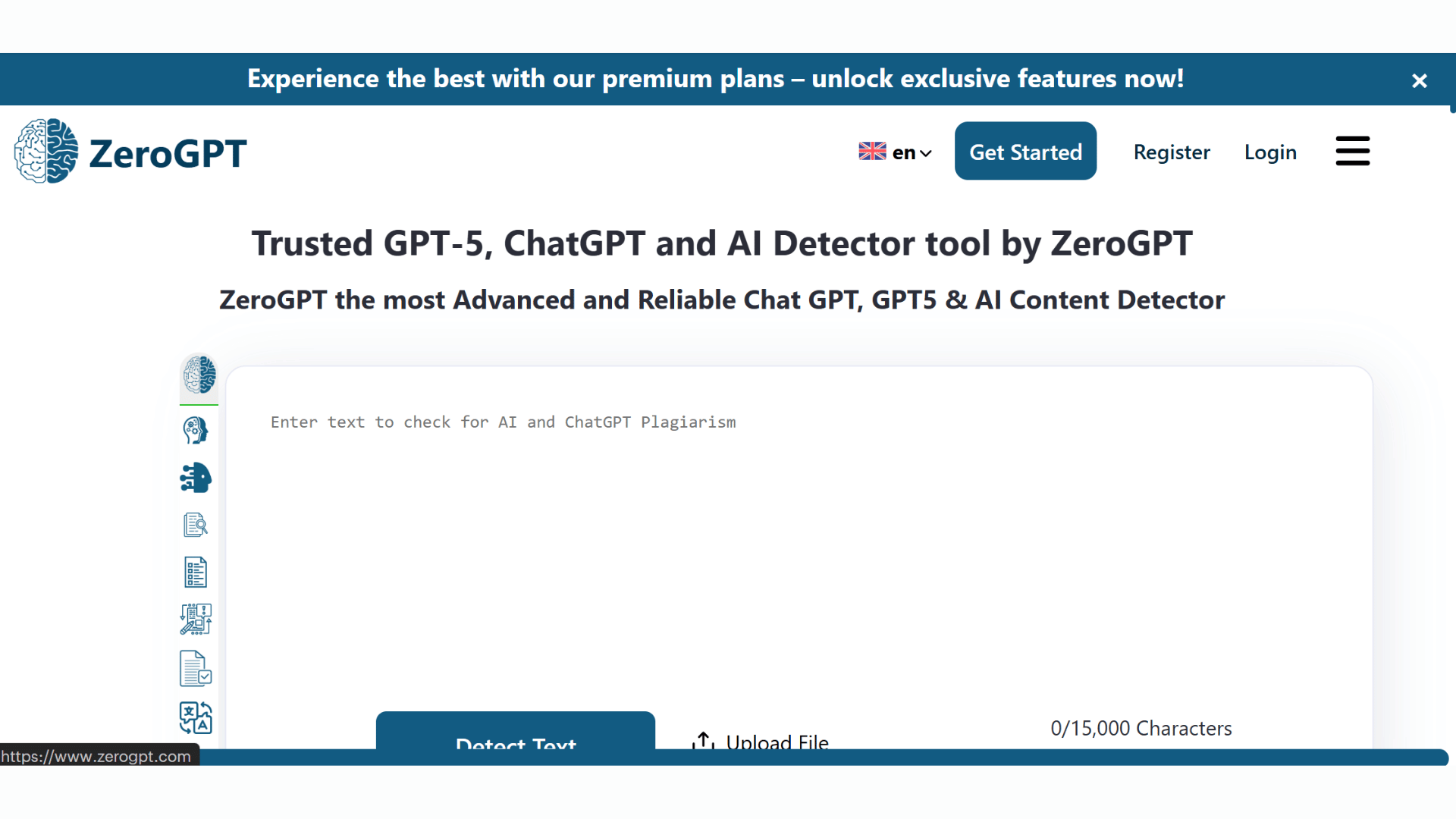
ZeroGPT is included mainly because students commonly encounter it as a public AI-checking tool.
- College relevance: 4/10 because accessibility is high but institutional relevance is comparatively weak.
- Independent research has reported both false-positive and false-negative problems across public AI detectors, including ZeroGPT.
- Research has also shown that detector performance can change after text is paraphrased, so a ZeroGPT percentage should not be treated as equivalent to a university detector result.
What AI Detectors Do Colleges Use According to Reddit?
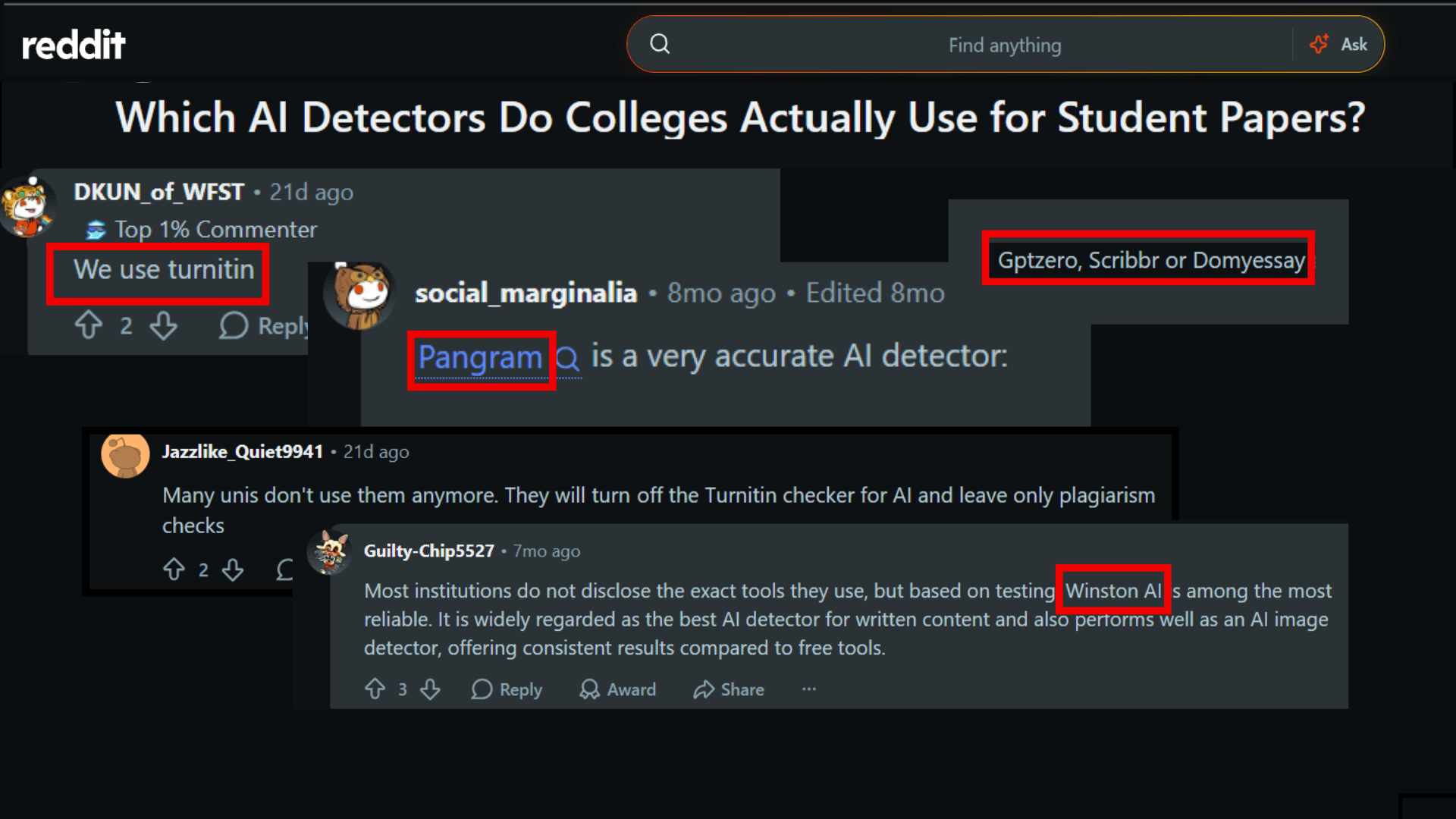
A Reddit discussion suggests that Turnitin is the AI detector students most commonly report encountering at college, although practices vary by institution.
Other tools also come up in educator discussions:
- Pangram: In one discussion, Pangram is described as a strong detector, reflecting its growing visibility among educators.
- Winston AI: In another discussion, Winston AI is mentioned as an alternative, although the commenter also notes that institutions often do not disclose exactly which tools they use.
- Detector scores are not usually treated as proof: A discussion says instructors may look for other evidence rather than relying on a detector result alone.
Why Different AI Detectors Give Different Scores
Two AI detectors can analyze the same essay and return different percentages because they use different models, training data, thresholds, language rules, and definitions of AI-assisted writing.
| What differs | How it can affect the result |
|---|---|
| Training and models | Different writing patterns are recognized |
| Text and language requirements | Some inputs are evaluated differently |
| Classification thresholds | The same signal may trigger different scores |
| Product updates | Results may change as models evolve |
False positives also matter. A Stanford-led study found that several detectors incorrectly flagged many human-written TOEFL essays by non-native English writers. This is why one detector score should support further review, not replace it.
Why Do Polished Human Writings Get Flagged as AI?
Polished or formal human writing can still be flagged because AI detectors do not determine who actually wrote a paper. Instead, they analyze patterns and estimate how closely the text resembles AI-generated writing.
Academic writing often uses consistent grammar, formal phrasing, clear transitions, predictable sentence structures, and a neutral tone.
These features can overlap with patterns detectors associate with AI, sometimes leading to false positives.
This does not mean polished writing is suspicious or that strong grammar proves AI use. Detector results are only predictions and can vary between tools.
A flagged paper should therefore be reviewed alongside drafts, citations, version history, earlier writing, and the student’s explanation.
Final Takeaway
Colleges do not rely on one universal AI detector. Turnitin is the most prominent institutional option, while Copyleaks, GPTZero, Pangram, and other tools may also appear depending on the college, course, or instructor.
Detector results are not standardized. Different models, thresholds, training data, and text requirements can produce different scores for the same essay, and false positives can affect genuine human writing.
That is why an AI percentage should be treated as a signal, not automatic proof of misconduct.
Which AI detector do you use to check your assignments or essays? Drop the name below and share your experience with it.
Frequently Asked Questions
Is There an AI Percentage That Automatically Gets You Flagged?
No. Colleges do not use one universal AI percentage as automatic proof of misconduct. Detector scores are typically reviewed alongside course policies and other evidence.
Can a Professor See Which Parts of an Essay Were Flagged?
Depending on the detector, yes. Some tools highlight specific sentences or passages and provide document-level indicators to help instructors review potentially AI-generated sections.
Can Students Check Their Work With the Same AI Detector as Their College?
Usually not exactly. Colleges may use institution-licensed tools or configurations that aren’t publicly available, so student-facing detectors are better treated as comparisons rather than replicas of professors’ results.
Does a 20% AI Score Mean You Cheated?
No. Turnitin’s 20% display boundary relates to how it reports lower scores, not a universal misconduct threshold. Course and institutional policies determine what happens next.
Can Human-Written College Essays Be Flagged as AI?
Yes. False positives can occur, so review AI detector results alongside drafts, writing history, assignment context, citations, and other evidence of authorship.