




Cybersecurity has become a critical business priority as organizations face increasingly complex digital threats and stricter compliance requirements.
The top cybersecurity companies help businesses protect sensitive data, secure networks, strengthen identity management, and respond to evolving cyber risks with confidence.
The right cybersecurity partner can strengthen an organization’s security posture and resilience.
Leading providers offer endpoint protection, cloud security, threat detection, and training tailored to business needs.
Use this guide to compare the industry’s leading cybersecurity companies and find the right fit for your organization’s security goals.
Quick Answer: Top Cybersecurity Companies
The top cybersecurity companies include CrowdStrike, Microsoft, Palo Alto Networks, Fortinet, Cisco, Zscaler, and Okta, among others.
These vendors are recognized for their strengths in endpoint protection, cloud security, identity management, and network defense.
The best choice depends on your organization’s size, IT environment, compliance needs, and risk profile.
Rather than relying on a single provider, most businesses benefit from a layered cybersecurity strategy that combines multiple tools and services for comprehensive protection
Key Factors Used to Evaluate Leading Cybersecurity Companies
The cybersecurity market includes providers with different strengths, specialties, and target audiences.
- Innovation and Technology Leadership: Consideration was given to product innovation, research efforts, and the adoption of advanced technologies to address evolving cyber threats.
- Threat Detection and Response Capabilities: Evaluation focused on the effectiveness of detecting, preventing, and responding to security incidents across diverse environments.
- Customer Adoption and Market Presence: Factors included customer trust, global reach, market influence, and adoption across industries of varying sizes.
- Cloud Security and AI Readiness: A strong emphasis was placed on cloud-native security offerings, AI-driven protection, and support for modern digital infrastructure.
- Independent Industry Recognition: Recognition from industry analysts, certifications, awards, and third-party evaluations contributed to the overall assessment.
Top Cybersecurity Companies
The cybersecurity industry includes a wide range of providers specializing in endpoint protection, cloud security, identity management, threat detection, and compliance.
1. Palo Alto Networks
Palo Alto Networks is a cybersecurity leader known for delivering integrated security across networks, cloud environments, endpoints, and security operations.
Its platform helps organizations prevent, detect, and respond to sophisticated cyber threats while supporting complex hybrid and multi-cloud infrastructures.
The company is widely recognized for unifying security functions that are often managed through separate tools.
- Primary Focus: Enterprise cybersecurity and cloud security.
- Best For: Large enterprises, government agencies, and global organizations.
- Key Products: Prisma Cloud, Cortex XDR, Cortex XSIAM, and Strata.
- Key Strength: Unified platform combining network, cloud, endpoint, and SOC security.
2. Microsoft
Microsoft has become a major cybersecurity provider by integrating security capabilities across its cloud, productivity, and identity platforms.
Its ecosystem helps organizations manage threats, secure cloud workloads, enforce compliance requirements, and protect user identities from a centralized environment.
Businesses already using Microsoft services often benefit from seamless security integration across their existing infrastructure.
- Primary Focus: Enterprise cloud security and identity management.
- Best For: Organizations invested in Microsoft environments.
- Key Products: Defender, Sentinel, and Entra ID.
- Key Strength: Deep integration across business applications and cloud services.
3. CrowdStrike
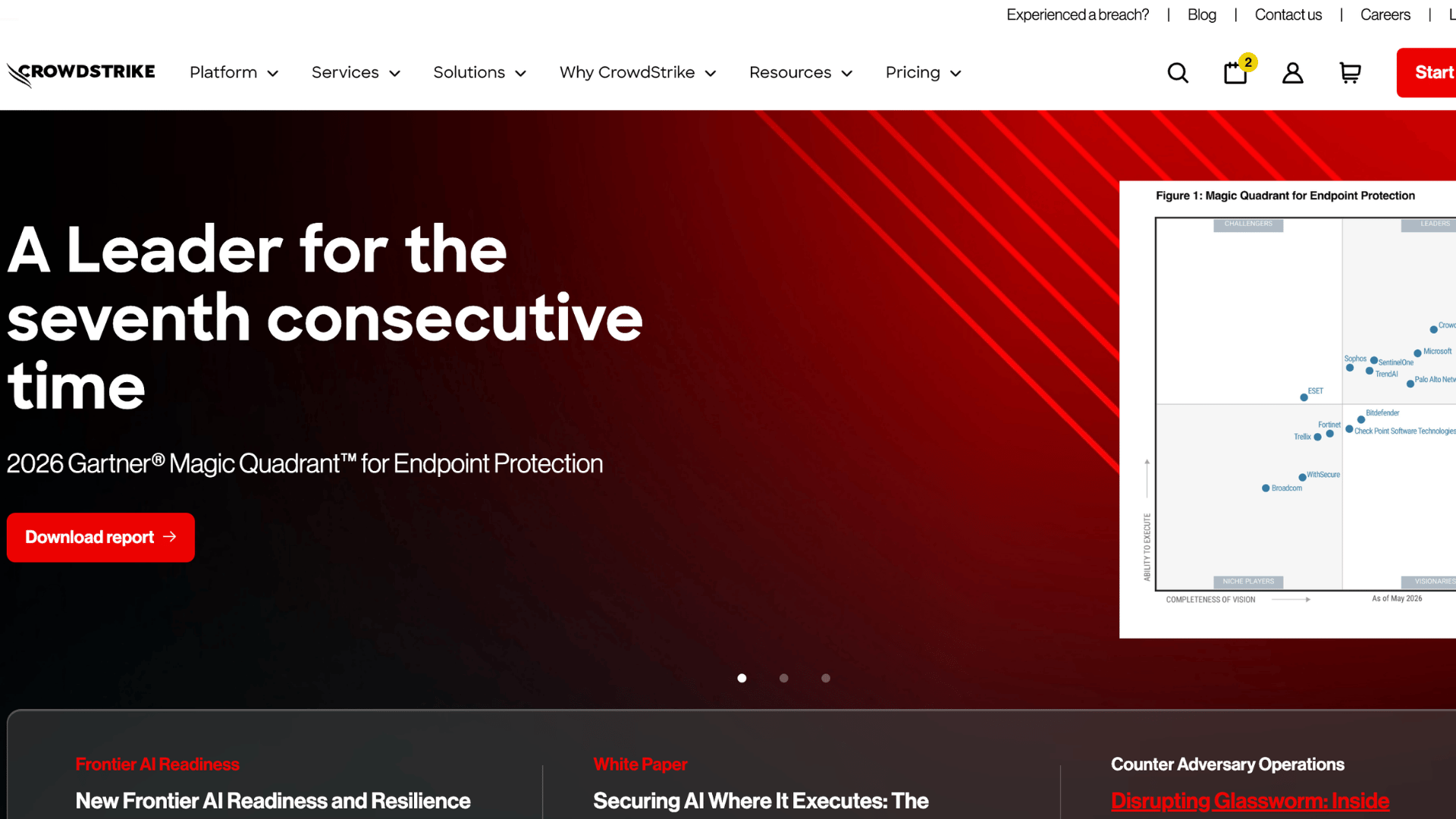
CrowdStrike specializes in endpoint protection and threat intelligence powered by artificial intelligence and real-time analytics.
Its cloud-native Falcon platform is widely adopted by enterprises seeking rapid threat detection, proactive threat hunting, and ransomware defense.
The company is frequently recognized for its ability to identify sophisticated attacks before they spread across organizational networks.
- Primary Focus: AI-driven endpoint detection and response.
- Best For: Large organizations facing advanced cyber threats.
- Key Products: Falcon Insight, Falcon Complete, and Falcon Prevent.
- Key Strength: Industry-leading threat detection and response capabilities.
4. Fortinet
Fortinet is a leading network security provider recognized for combining security and networking through its integrated platform.
The company offers solutions that protect data centers, branch offices, cloud environments, and remote users.
Its Security Fabric connects multiple security functions, allowing organizations to improve visibility, automate responses, and strengthen protection across distributed infrastructures.
- Primary Focus: Network security and secure networking.
- Best For: Enterprises managing complex network environments.
- Key Products: FortiGate, FortiManager, and FortiAnalyzer.
- Key Strength: Unified security architecture across networks.
5. Cisco
Cisco delivers cybersecurity solutions that extend beyond networking to include cloud security, threat intelligence, endpoint protection, and secure access.
Backed by Talos, one of the world’s largest commercial threat intelligence teams, Cisco helps organizations identify and respond to emerging threats.
Its broad portfolio makes it a common choice for enterprises seeking integrated security and networking capabilities.
- Primary Focus: Enterprise network and cloud security.
- Best For: Large organizations with hybrid infrastructures.
- Key Products: Secure Firewall, SecureX, and Umbrella.
- Key Strength: Extensive threat intelligence through Cisco Talos.
6. Zscaler
Zscaler is a cloud-native cybersecurity company best known for pioneering Zero Trust security and secure access service edge (SASE) solutions.
Its platform enables users to securely access applications and data without relying on traditional network architectures.
Organizations undergoing cloud transformation often choose Zscaler to improve security, simplify access controls, and reduce reliance on legacy VPN technologies.
- Primary Focus: Zero Trust network access and cloud security.
- Best For: Cloud-first organizations and distributed workforces.
- Key Products: ZIA, ZPA, and ZDX.
- Key Strength: Eliminates traditional network security limitations.
7. SentinelOne
SentinelOne specializes in AI-powered endpoint security, offering autonomous threat detection, prevention, and response capabilities.
Its platform helps security teams rapidly identify and contain ransomware, malware, and advanced attacks across endpoints, cloud workloads, and identities.
The company is particularly known for reducing manual security operations through automation and real-time analytics.
- Primary Focus: Endpoint detection and response (EDR/XDR).
- Best For: Mid-sized to large organizations seeking automated threat response.
- Key Products: Singularity Endpoint, Singularity XDR, and Singularity Cloud Security.
- Key Strength: Automated threat remediation with minimal analyst intervention.
8. Trend Micro
Trend Micro focuses on protecting cloud environments, endpoints, servers, and connected devices through a unified security approach.
The company has built a strong reputation in hybrid cloud security and extended detection and response technologies.
Organizations operating across multiple environments often rely on Trend Micro for centralized visibility, threat intelligence, and protection against evolving cyber risks.
- Primary Focus: Hybrid cloud and XDR security.
- Best For: Businesses operating across mixed environments.
- Key Products: Vision One, Cloud One, and Apex One.
- Key Strength: Strong protection for hybrid cloud infrastructures.
9. Okta
Okta is a leading identity security company that helps organizations manage and secure access to applications, devices, and digital resources.
Its platform enables seamless authentication while reducing the risk of unauthorized access.
With support for workforce and customer identity management, Okta has become a popular choice for businesses seeking scalable identity solutions across modern cloud environments.
- Primary Focus: Identity and access management.
- Best For: Organizations securing employee and customer identities.
- Key Products: Workforce Identity Cloud and Customer Identity Cloud.
- Key Strength: Flexible identity management across cloud applications.
10. Proofpoint
Proofpoint is widely recognized for protecting organizations against email-based threats, including phishing, malware, business email compromise, and insider risks.
Its solutions focus on securing one of the most frequently targeted attack vectors while helping businesses maintain regulatory compliance.
The company also provides threat intelligence and user-focused security tools designed to reduce human-driven security risks.
- Primary Focus: Email security and phishing protection.
- Best For: Organizations prioritizing communication security.
- Key Products: Email Protection and Targeted Attack Protection.
- Key Strength: Advanced defense against email-borne threats.
11. Tenable
Tenable is known for helping organizations identify, assess, and prioritize cybersecurity vulnerabilities before attackers can exploit them.
The company pioneered vulnerability management through its Nessus platform and has expanded into broader exposure management solutions.
Its technology provides security teams with actionable insights that support risk-based decision-making across cloud, on-premises, and hybrid environments.
- Primary Focus: Vulnerability and exposure management.
- Best For: Organizations focused on proactive risk reduction.
- Key Products: Nessus, Tenable One, and Tenable.io.
- Key Strength: Extensive visibility into cyber exposure risks.
12. Check Point Software
Check Point Software delivers multilayered cybersecurity solutions designed to protect networks, cloud environments, endpoints, and mobile devices.
Its Infinity architecture integrates prevention-focused technologies that help stop threats before they cause damage.
The company is particularly valued by enterprises seeking consistent security policies and centralized management across diverse digital infrastructures.
- Primary Focus: Threat prevention and network security.
- Best For: Enterprises requiring layered security controls.
- Key Products: Quantum, CloudGuard, and Harmony.
- Key Strength: Prevention-first approach to cybersecurity protection.
13. IBM
IBM provides enterprise-grade cybersecurity solutions that combine threat detection, incident response, identity security, and security operations.
Leveraging its extensive expertise in AI and enterprise IT, IBM helps organizations manage cyber risks across complex business environments.
Its offerings are further strengthened by global threat intelligence and a large cybersecurity consulting practice.
- Primary Focus: Security operations, identity security, and threat management.
- Best For: Large enterprises with complex security and compliance requirements.
- Key Products: QRadar Suite, Verify, Guardium, and X-Force Services.
- Key Strength: Deep integration of security operations, compliance, and consulting expertise.
14. BigID
BigID focuses on data security, privacy, governance, and compliance by helping organizations find, classify and manage sensitive data across cloud, SaaS, and on-premises environments.
Its platform enables businesses to reduce data risk while meeting evolving regulatory requirements. The company is especially recognized for providing visibility into sensitive and regulated data at scale.
- Primary Focus: Data security posture management and privacy compliance.
- Best For: Organizations managing large volumes of sensitive or regulated data.
- Key Products: BigID Data Security Platform, DSPM, and Data Privacy Suite.
- Key Strength: Advanced data discovery and classification across distributed environments.
15. Immuta
Immuta delivers data access governance and security solutions that help organizations control who can access sensitive data and under what conditions.
Its platform automates policy enforcement across data platforms, enabling secure data sharing while maintaining compliance.
The company helps organizations balance data accessibility with strict security and privacy requirements.
- Primary Focus: Data access governance and policy-based security.
- Best For: Data-driven enterprises in regulated industries.
- Key Products: Immuta Data Security Platform and Automated Data Access Control.
- Key Strength: Fine-grained, automated access controls for sensitive data environments.
16. Varonis
Varonis specializes in data security by helping organizations identify, protect, and monitor sensitive information across cloud, SaaS, and on-premises environments.
Its platform continuously analyzes data access, user behavior, and permissions to reduce insider threats, ransomware risks, and data exposure.
The company is particularly known for securing unstructured data stored across enterprise systems.
- Primary Focus: Data security and insider risk management.
- Best For: Enterprises managing large volumes of sensitive and unstructured data.
- Key Products: Varonis Data Security Platform, DatAdvantage, and Data Classification Engine.
- Key Strength: Deep visibility into data access patterns and permission risks.
17. Cloudflare
Cloudflare provides cloud-native security and performance services that help organizations protect applications, networks, and users from cyber threats.
Its globally distributed network delivers web security, DDoS protection, Zero Trust access controls, and application performance optimization from a single platform.
The company is widely recognized for securing internet-facing infrastructure at massive scale.
- Primary Focus: Network security, application security, and Zero Trust access.
- Best For: Businesses seeking scalable cloud-based security and performance solutions.
- Key Products: Cloudflare One, Web Application Firewall (WAF), DDoS Protection, and Magic Transit.
- Key Strength: Global edge network that combines security, connectivity, and performance.
Best Cybersecurity Companies for Specific Industries
Different industries face unique cybersecurity challenges, from protecting patient records and financial transactions to securing cloud applications and industrial systems.
| Industry | Recommended Cybersecurity Companies | Why They Stand Out |
|---|---|---|
| Healthcare Organizations | Microsoft, Proofpoint, Fortinet | Help secure patient data, support compliance requirements, and protect healthcare networks from ransomware attacks. |
| Financial Services | CrowdStrike, Okta, Ping Identity | Deliver advanced threat detection, fraud prevention, and strong identity security for highly regulated environments. |
| Government Agencies | Cisco, Check Point Software, Microsoft | Provide enterprise-grade security, threat intelligence, and scalable protection for critical infrastructure. |
| Retail and E-Commerce | Proofpoint, Fortinet, Duo Security | Protect customer information, payment systems, and online transactions while reducing phishing-related risks. |
| Manufacturing and Industrial Operations | Trend Micro, Fortinet, Check Point Software | Secure operational technology (OT), industrial networks, and connected devices across production environments. |
| SaaS and Technology Companies | Zscaler, CrowdStrike, Okta | Support cloud-native architectures, remote workforces, and secure access to applications and digital services. |
Cybersecurity Company Categories
Cybersecurity companies often specialize in different areas of protection, ranging from endpoint security and identity management to cloud protection and vulnerability assessment.
- Endpoint Security Companies: Focus on protecting devices such as laptops, desktops, servers, and mobile devices from malware, ransomware, and unauthorized access.
- Cloud Security Providers: Secure cloud applications, workloads, and infrastructure while helping organizations manage risks across multi-cloud environments.
- Identity and Access Management Vendors: Control user authentication and permissions to ensure only authorized individuals can access critical systems and data.
- Network Security Leaders: Protect organizational networks through firewalls, intrusion prevention systems, secure access controls, and traffic monitoring.
- Managed Detection and Response Providers: Deliver continuous threat monitoring, investigation, and incident response through dedicated security operations expertise.
- Security Awareness Training Companies: Help employees recognize phishing attempts, social engineering tactics, and other human-focused cyber threats.
- Vulnerability Management Specialists: Identify, prioritize, and remediate security weaknesses before attackers can exploit them.
How to Choose the Right Cybersecurity Company?
Selecting the right cybersecurity company starts with understanding your organization’s most significant security risks, whether they involve ransomware, phishing, cloud vulnerabilities, or identity threats.
It is equally important to evaluate your existing infrastructure and ensure potential solutions integrate smoothly with current systems and workflows.
Organizations operating in regulated industries should also consider compliance requirements and reporting capabilities.
Comparing pricing models can help determine long-term value, while reviewing service-level agreements (SLAs) provides insight into response times and support quality.
Before making a decision, request product demonstrations or trials to assess usability, effectiveness, and overall alignment with your security objectives.
Emerging Cybersecurity Trends Shaping the Industry
As cyber threats become more sophisticated, organizations are adopting new technologies and security frameworks to strengthen their defenses.
- AI-Powered Threat Detection: Artificial intelligence helps identify suspicious activities, automate threat analysis, and accelerate incident response.
- Zero Trust Security Adoption: Organizations are increasingly verifying every user and device before granting access to sensitive resources.
- Extended Detection and Response (XDR): XDR platforms integrate data from multiple security tools to improve threat visibility and investigative capabilities.
- Secure Access Service Edge (SASE): SASE integrates networking and security functions to support secure access across distributed environments.
- Cloud-Native Security Platforms: Businesses are adopting security solutions specifically designed for cloud workloads, applications, and infrastructure.
- Identity-First Security Strategies: Greater emphasis is being placed on securing identities as a primary defense against unauthorized access and breaches.
- AI-Generated Attack Surfaces: As organizations adopt generative AI tools, new attack vectors are emerging around prompt injection, model poisoning, and unsecured AI APIs.
Conclusion
It depends on your size, security needs, infrastructure, and compliance requirements.
While some providers specialize in endpoint protection, others focus on identity management, cloud security, vulnerability assessment, or managed detection and response services.
Understanding these strengths can make it easier to identify a solution that aligns with your specific needs.
I find that the most effective cybersecurity strategies combine the right technology, expert support, and proactive risk management.
By evaluating vendors carefully and aligning their capabilities with your objectives, you can build a stronger security foundation and better protect your organization against evolving cyber threats.
Frequently Asked Questions
What Is the Typical Cost of Cybersecurity Services?
Cybersecurity service costs vary based on organization size, security requirements, and service scope, ranging from a few hundred to several thousand dollars monthly.
Which Certifications Should a Cybersecurity Provider Have?
Trusted cybersecurity providers often hold certifications such as ISO 27001, SOC 2, CISSP, CISM, and relevant compliance credentials demonstrating security expertise.
Are Managed Cybersecurity Services Worth the Investment?
Managed cybersecurity services provide continuous monitoring, threat detection, and expert support, helping organizations strengthen security while reducing operational complexity and staffing requirements.