






Data breaches are expensive. IBM’s Cost of a Data Breach Report 2025 puts the global average at 4.44 million dollars per breach, and 10.22 million dollars in the United States.
In my experience reviewing post-incident assessments, a recurring root cause is simple: the organization did not know where its sensitive data lived until attackers found it first.
If you keep hearing about DSPM but do not know what it means, this guide will help.
You will learn what is DSPM, how it works, why it matters, and how it protects your data better than old security tools. We will cover data security posture management from start to finish using simple words and real examples.
What is DSPM and Why does it Matter
Quick Answer: DSPM stands for data security posture management. It is a data-first security approach that continuously discovers sensitive data across cloud, SaaS, and on-premises environments, classifies it by sensitivity, identifies who can access it, and fixes exposure risks before they become breaches.
Unlike older tools that guard the network perimeter, DSPM protects the actual data itself. That means it follows your data wherever it goes.
The DSPM’s meaning becomes clear when you understand the problem it solves. Companies now store data across many platforms, such as AWS, Azure, Google Cloud, and SaaS apps.
This data sprawl creates blind spots. Security teams cannot answer basic questions like where sensitive data is stored or who has access to it.
DSPM fixes this by giving complete visibility. Gartner first named DSPM as a category in its 2022 Hype Cycle for Data Security, and it has since become a standard line item in cloud security budgets.
Companies that ignore the problem face higher breach risks and compliance fines. Here is how the technology works in practice.
How DSPM Works Step by Step
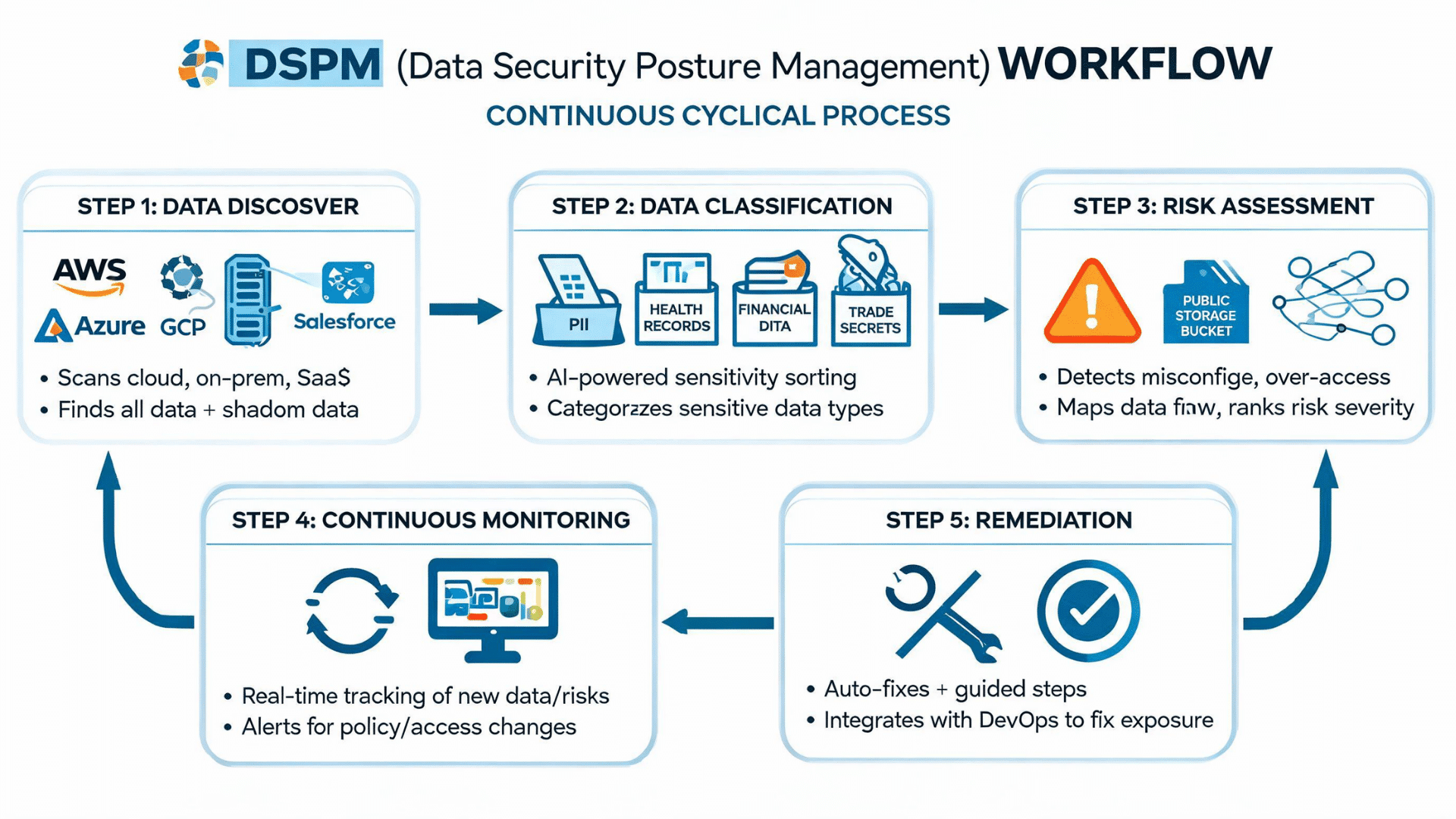
DSPM follows a clear process to find, classify, and protect sensitive data. The workflow has five main steps that run continuously.
Step One: Data Finding
DSPM tools automatically scan your entire environment. They look across cloud platforms like Amazon Web Services, Microsoft Azure, and Google Cloud Platform.
They also check on-premises systems and SaaS applications like Salesforce. The scan finds all data, including shadow data that IT does not know about.
Shadow data happens when teams create copies of sensitive data without telling security teams.
I have seen this firsthand during security assessments.
In one engagement, a single production customer database had spawned eleven copies: developer snapshots, an analytics export, a vendor test set, and several forgotten backups.
The security team knew about three of them. That gap between assumed and actual data inventory is exactly what DSPM exists to close.
Step Two: Data Classification
Once found, DSPM sorts data by sensitivity. It identifies personally identifiable information, health records, financial data, and trade secrets.
The tool uses artificial intelligence to understand what the data is, not just simple pattern matching. This classification tells you which data needs the strongest protection.
Step Three: Risk Assessment
DSPM checks how well each data asset is protected. It looks for misconfigurations like public storage buckets.
It finds overentitlements where users have too much access. It maps data flow to see where data moves and where risks exist.
The tool ranks risks by severity, so you fix the worst problems first. This prioritization matters more than it sounds. Teams I have worked with rarely lack findings.
They lack a defensible way to decide which of 4,000 findings to fix this sprint. Good DSPM scoring answers that question with data sensitivity and exposure context rather than raw vulnerability counts.
Step Four: Continuous Monitoring
DSPM does not stop after the initial scan. It keeps watching your environment for new data, new risks, and policy violations.
When data moves or access changes, DSPM detects it right away. This real-time tracking catches problems before they become breaches.
Step Five: Remediation
When DSPM finds a risk, it helps you fix it. Some tools auto-fix issues like closing public access. Others provide step-by-step instructions or integrate with your DevOps workflow.
The goal is fast remediation that stops exposure. This process repeats continuously, which is why data security posture management stays effective as your environment changes.
Key Capabilities of DSPM Tools
Modern DSPM platforms offer several core features that work together to protect data.
- Comprehensive Data Finding: DSPM scans all environments without needing agents on each system. It finds structured data in databases and unstructured data in files. It locates shadow data in unauthorized cloud services.
- Smart Data Classification: AI-powered classification goes beyond simple rules. It understands context like data owner, sensitivity level, and applicable regulations.
- Access Governance and Least Privilege: DSPM shows who has access to what data. This visibility helps enforce least-privilege access, meaning people only get the access required for their jobs.
- Vulnerability and Misconfiguration Detection: The tool identifies security gaps such as unencrypted data, missing patches, and open permissions. It links these vulnerabilities to specific data assets, so you know which risks matter most.
- Compliance Support: DSPM helps meet requirements for GDPR, HIPAA, CCPA, and PCI DSS. It shows where regulated data exists and is properly protected. The tool generates audit-ready reports that prove compliance. Many platforms also map findings to control frameworks such as the NIST Cybersecurity Framework, which makes audit conversations faster.
- Real-Time Threat Detection: DSPM monitors abnormal access patterns that indicate insider threats or attacks. When it detects suspicious activity, it alerts your team immediately.
DSPM Versus CSPM: Understanding the Difference
Many people confuse DSPM with CSPM, but they protect different things. Understanding this difference helps you build a complete security strategy.
| Feature | DSPM | CSPM |
|---|---|---|
| Focus area | Sensitive data visibility and protection | Cloud infrastructure configuration |
| Primary goal | Reduce data exposure and maintain compliance | Fix cloud misconfigurations |
| What it secures | The data itself | The cloud environment that holds the data |
| Key capabilities | Data finding, classification, and access analysis | Resource scanning, policy enforcement |
| Security layer | Data layer | Infrastructure layer |
| Compliance support | GDPR, HIPAA, CCPA | CIS benchmarks, NIST, ISO |
CSPM finds misconfigured virtual machines, storage settings, and network rules. It ensures your cloud setup follows best practices.
DSPM finds sensitive data inside that cloud setup and ensures the data is protected. You need both tools for full security. CSPM secures the castle walls, while DSPM protects the treasure inside.
Without DSPM, you might have secure infrastructure but still expose sensitive data through overly permissive access.
Without CSPM, your data might be classified correctly but sit in a misconfigured bucket that anyone can access.
In assessments, I find the second failure mode more often than people expect. A CSPM dashboard showing all green tells you nothing about whether a correctly configured bucket contains a payroll export that forty contractors can read.
Real Use Cases for DSPM
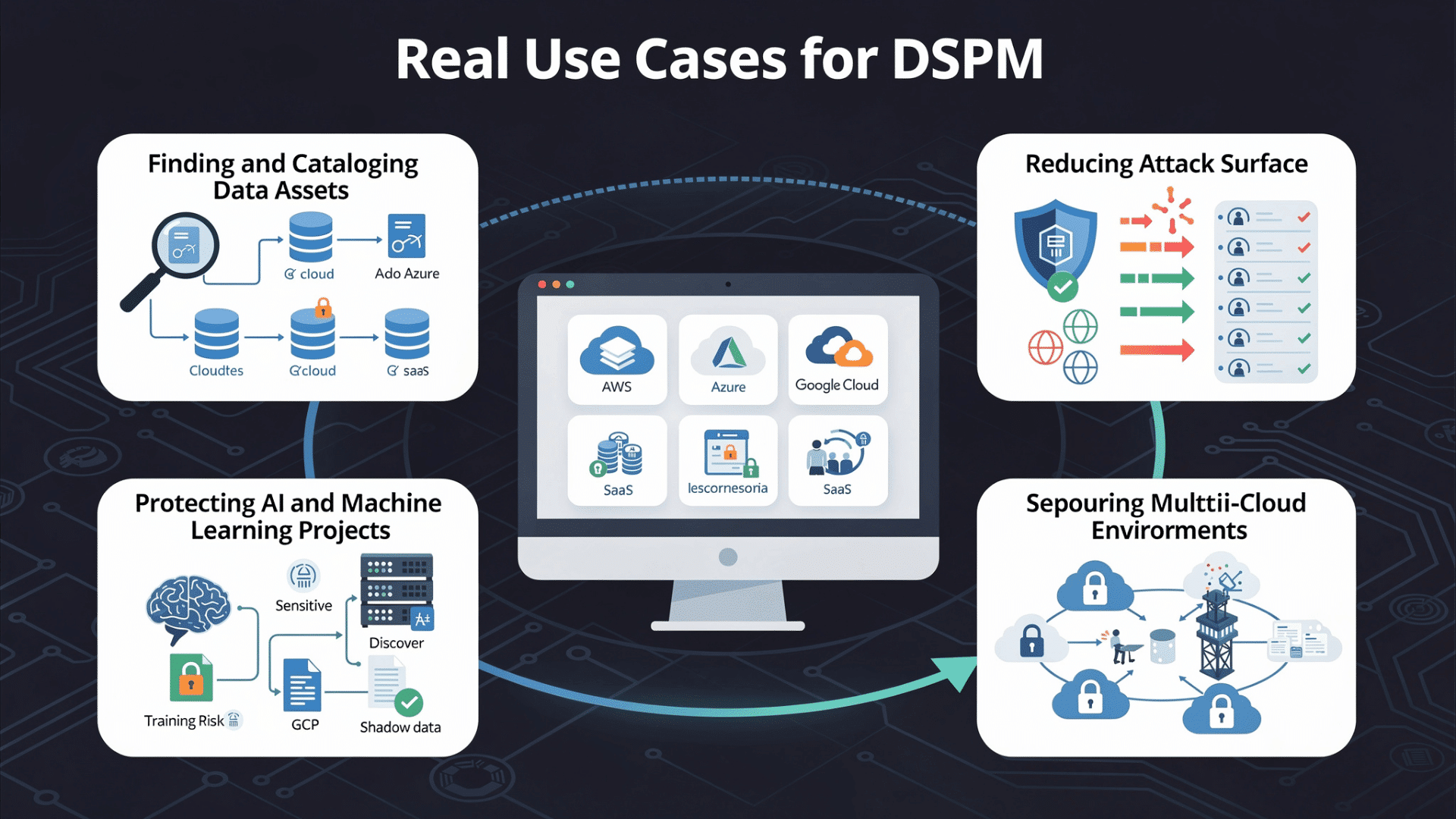
Organizations use DSPM for many practical security needs. These use cases show how data security posture management solves real problems.
- Finding and Cataloging Data Assets: Companies with complex multi-cloud setups cannot manually track where data lives. DSPM automatically locates and catalogs data across AWS, Azure, Google Cloud, and SaaS apps.
- Reducing Attack Surface: DSPM shows where sensitive data sits and who can access it. Security teams use this view to find attack vectors and close them.
- Enforcing Least Privilege Access: Overpermissioned accounts cause many breaches. DSPM tracks all access permissions and flags users with too much access.
- Securing Multi-Cloud Environments Enterprises using multiple cloud providers struggle with inconsistent security. DSPM provides one unified view of all data assets regardless of platform.
- Supporting Cloud First Strategies: DSPM finds and classifies data as it moves to the cloud. It identifies risks during migration and monitors data after the move.
- Protecting AI and Machine Learning Projects: AI projects need large datasets, which creates shadow data risks. Teams copy sensitive data to training pipelines without proper security. DSPM finds this data and ensures it has the correct protection.
Benefits of Adopting DSPM
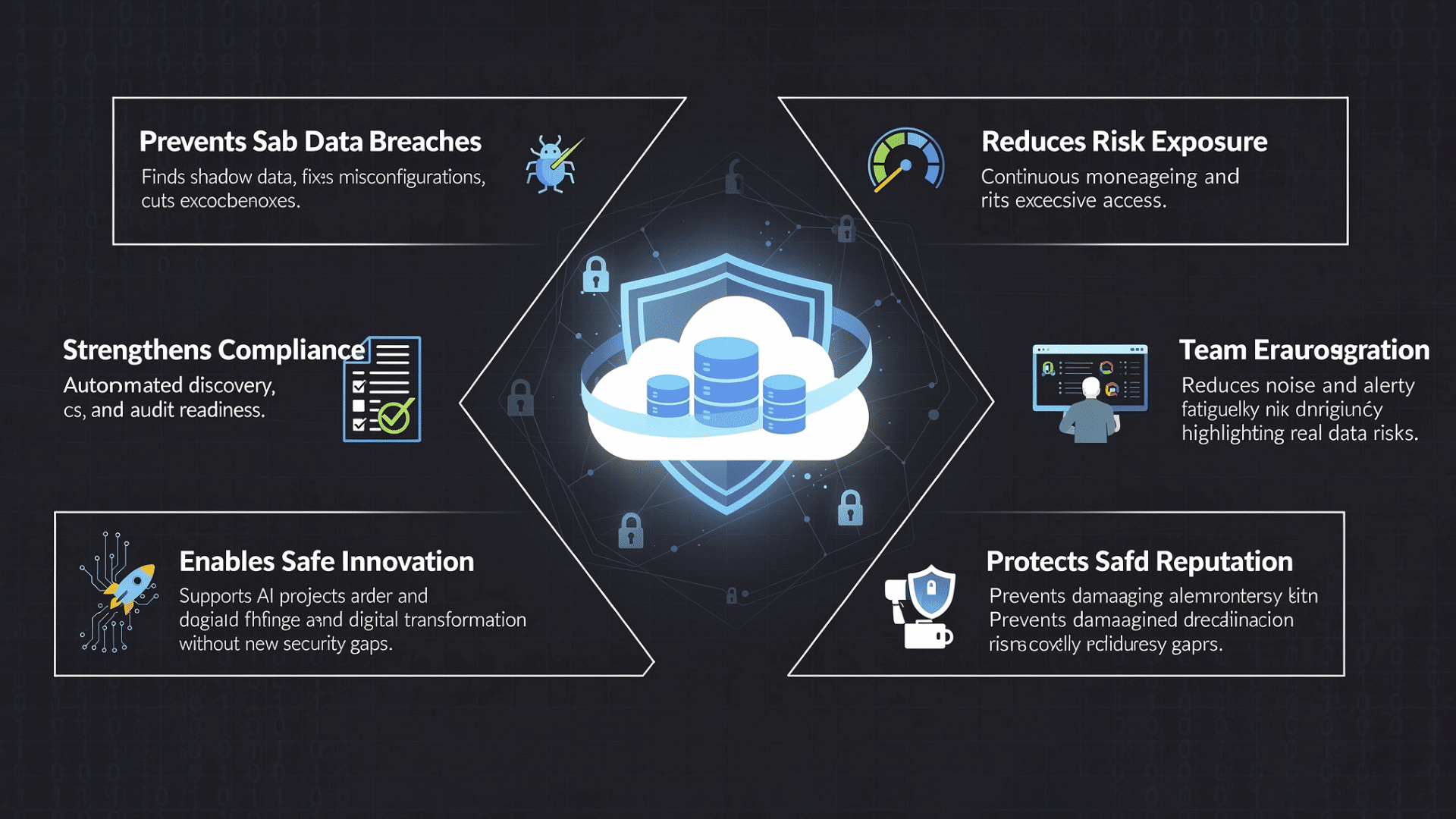
Implementing data security posture management delivers clear benefits that protect your business.
- Prevents Data Breaches: DSPM finds risks before attackers do. By finding shadow data, fixing misconfigurations, and removing excessive access, you close the paths attackers use.
- Reduces Risk Exposure: Continuous monitoring means you know your risk level at all times. DSPM prioritizes risks by severity, so you focus on what matters.
- Strengthens Compliance: Manual compliance audits take weeks and miss things. DSPM automates finding and classification, making compliance easier.
- Improves Security Team Efficiency: Security teams face alert fatigue from too many warnings. DSPM reduces noise by focusing on real data risks.
- Enables Safe Innovation: DSPM removes the fear that new projects will create security gaps. This confidence supports AI adoption and digital transformation.
- Protects Brand Reputation: DSPM prevents breaches that cause reputation harm. Protecting your brand saves money that would go to customer recovery and public relations.
What DSPM Will Not Do
Vendor pages rarely say this part out loud, so I will. DSPM is valuable, and it has limits worth knowing before you buy.
| Limitation | What It Means | What Teams Should Do |
|---|---|---|
| Classification will not be perfect on day one | Every classification engine creates false positives and can miss some data. | Plan for a tuning period so the tool can learn your internal document types. |
| The first scan can feel overwhelming | A mature cloud setup may return thousands of findings during the first scan. | Set severity thresholds and a triage plan before running the scan. |
| DSPM does not fix culture | If teams keep copying production data into test environments, DSPM will keep flagging the issue. | Support DSPM with clear policies, training, and management backing. |
| DSPM is not an incident response tool | It helps reduce breach risk and limits damage, but it does not replace response tools. | Keep detection, response, and recovery capabilities in place alongside DSPM. |
How to Choose a DSPM Solution
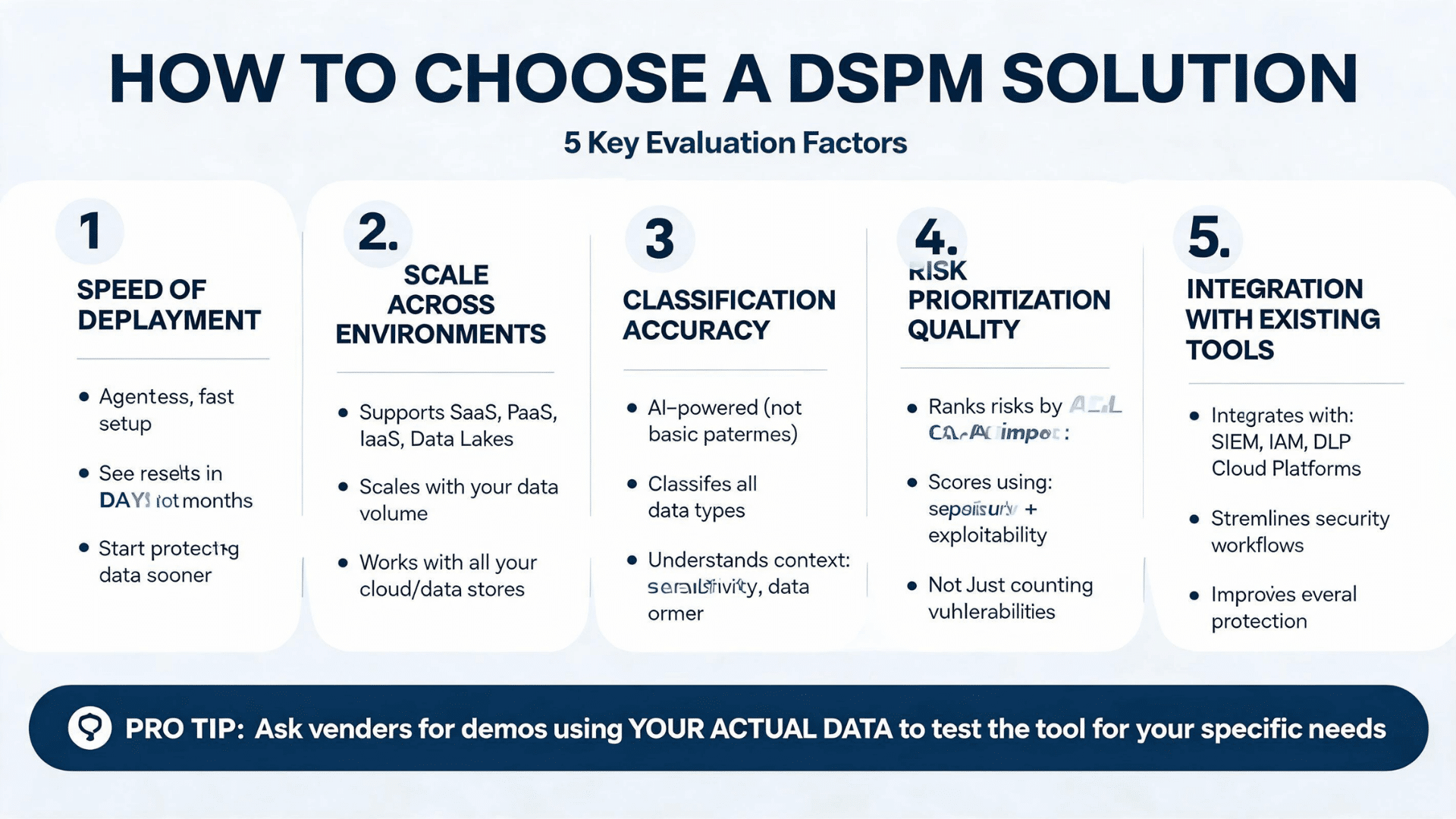
Not all DSPM tools work the same way. When evaluating options, check these five factors.
- Speed of Deployment: Look for agentless solutions that work quickly. You should see results within days, not months. Fast deployment means you start protecting data sooner.
- Scale Across Environments: The tool must handle your data volume and grow with you. Check that it supports all your cloud providers and data stores. It should work across SaaS, PaaS, IaaS, and data lakes.
- Classification Accuracy: Test how well the tool classifies different data types. Good DSPM uses AI, not just simple patterns. It should understand context like data owner and sensitivity level.
- Risk Prioritization Quality: The tool should rank risks by actual impact, not just count vulnerabilities. Look for scoring that considers data sensitivity, exposure level, and exploitability.
- Integration with Existing Tools: DSPM should work with your security stack. Check integrations with SIEM, IAM, DLP, and cloud platforms.
DSPM Best Practices for Success
Getting the most from data security posture management requires following proven practices.
| Best Practice | Description | Benefit |
|---|---|---|
| Start with Data Discovery | Identify and map sensitive data across all environments before implementing additional security controls. | Provides visibility into where critical data resides and helps accurately assess risk. |
| Define Clear Policies | Develop data security policies with input from security, cloud, and compliance teams. Set risk thresholds based on business requirements. | Ensures consistent protection and aligns security efforts with organizational goals. |
| Align with Regulatory Requirements | Configure DSPM policies to comply with applicable industry regulations and standards. | Helps maintain compliance and reduces regulatory risks. |
| Implement DSPM in Phases | Begin with high-risk environments or sensitive data types, then gradually expand coverage. | Delivers quick wins, demonstrates value, and simplifies deployment. |
| Combine DSPM with CSPM | Use DSPM to protect data and CSPM to secure cloud infrastructure. | Provides comprehensive cloud security coverage across both data and infrastructure. |
| Train Security Teams | Educate staff on interpreting DSPM risk scores, alerts, and remediation recommendations. | Improves response effectiveness and maximizes the value of the tool. |
| Review and Update Policies Regularly | Continuously adjust policies as cloud environments, threats, and business requirements change. | Keeps DSPM effective and ensures ongoing protection against evolving risks. |
| Follow a Continuous Improvement Approach | Monitor results, address findings, and refine security processes over time. | Strengthens the organization’s overall data security posture and reduces long-term risk. |
Final Thoughts
You now know what DSPM is and why data security posture management matters for modern organizations.
DSPM finds sensitive data across all environments, classifies it by risk, and helps fix security gaps before breaches happen.
It works differently from CSPM and DLP, and the three cover different layers, so mature security programs end up running all of them together.
The simplest readiness test I give teams is one question: can you tell me, today, where every copy of your most sensitive dataset lives and who can access it?
If the answer takes more than a few minutes, DSPM belongs on your evaluation list.
Start by evaluating DSPM solutions that fit your cloud stack. Ask for demos, test classification accuracy, and check integration options. Take action before a breach forces the conversation for you.
Frequently Asked Questions About DSPM
Can DSPM Work with Multiple Cloud Providers?
Yes, DSPM supports all major cloud platforms including AWS, Azure, Google Cloud, and Snowflake. It works across SaaS, PaaS, and IaaS services.
Does DSPM Replace CSPM?
No, DSPM does not replace CSPM.
What Types of Data does DSPM Find?
DSPM finds personally identifiable information, health records, financial data, intellectual property, and payment card information.
Is DSPM Hard to Implement?
DSPM deployment is easier with agentless solutions. You can start seeing results in days, not months.
What Compliance Frameworks Does DSPM Support?
DSPM helps meet GDPR, HIPAA, CCPA, PCI DSS, and other data protection regulations.